A Year-Round Capsule Wardrobe Checklist, Season by Season
A capsule wardrobe works best when it is built in two parts: a core that stays all year, and a smaller set of seasonal pieces that rotate in and out. This year-round capsule wardrobe checklist uses that structure, so you are never rebuilding from scratch — just swapping a few pieces as the weather changes.
This guide gives the core, the four seasonal additions, and how to adjust it for your climate and week. More in our Outfit Ideas section.
Build a core of around twenty pieces that works in every season, then add five to ten seasonal pieces for each quarter. The core never changes; only the edges do.
How a Year-Round Capsule Is Structured
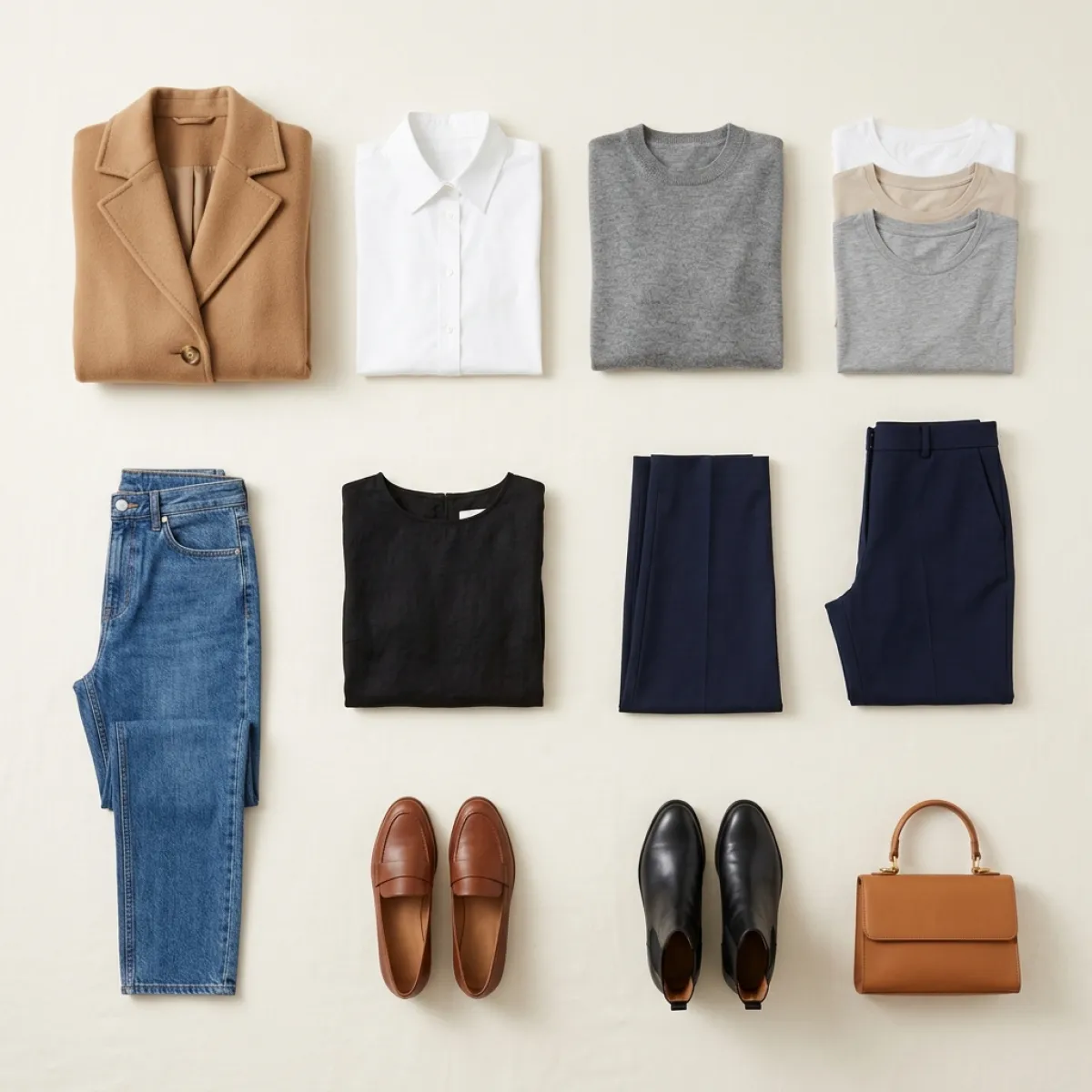
Every piece in a capsule does a job. Thinking in roles rather than items makes gaps obvious: you need an overlayer, an underlayer, a workhorse bottom, a dress-up bottom, an easy dress, a walking shoe, another shoe and something to carry. The builder uses exactly these eight roles.
This is a general list. A mild climate needs fewer winter pieces; an office week needs more tailoring; a uniform at work changes the whole thing. The builder asks about your climate, season, week and how many pieces you want, and produces a checklist you can print, with your palette across the top.
Colour is what makes a capsule work. Choose two or three neutrals for the core and let the seasonal pieces bring in your main colours. The personal colour palette generator gives you both.
European Wardrobe Essentials: The 10 Pieces That Do the Work
Ask what a European woman keeps in her wardrobe and you will get a list. Trench coat, white shirt, straight trousers, flats. The list is accurate enough — walk through Copenhagen or Milan and you will see most of it — but owning the ten items does not produce the result, which is why so many people buy the list and end up looking like they bought a list.
What follows is the same ten European wardrobe essentials with the reasoning attached: what each one does in an outfit, what makes a good one, and what happens when it is missing. If you want the argument rather than the inventory, the companion piece on how European women actually get dressed covers the five principles underneath all of this. Both sit in our European Style guides.
European wardrobes are small and repetitive by design. Ten well-chosen pieces in a coherent palette produce more outfits than thirty that were bought one at a time, because each new item has to work with everything already there.
What Makes This a European Wardrobe Rather Than Just a Small One
The size of a European wardrobe is a consequence, not a goal. Most of the budget goes on fit and fabric — a coat that sits properly at the shoulder, trousers in a wool with enough weight to hold their line — and when each piece costs a little more and lasts a lot longer, the count stays low on its own.
The palette is the second half of it. Neutrals that all work with each other — navy, camel, grey, cream, black, a single accent colour — mean almost anything in the wardrobe combines with almost anything else. That is what makes repetition invisible: the same trousers worn three times in a week look different each time because the pieces around them change.
The third half, if a wardrobe can have three, is restraint. One piece per outfit carries the interest — a coloured bag, a good shoe, a striking earring — and the rest stays quiet so that it can.
This is a European convention rather than a rule. Copenhagen wears trainers with tailoring and Milan does not; both are working from the same ten pieces. Our guide to Copenhagen style shows how differently the same basics can be worn.
European Wardrobe Essentials: The Ten Pieces
01 — A Coat That Fits the Shoulders
What it does: sets the silhouette of every outfit worn under it from October to March, and is the piece most often seen.
What makes a good one: the shoulder seam sitting where your shoulder ends, enough room for a knit underneath, and a length that works with both trousers and a dress.
Where it goes wrong: buying for the colour rather than the shoulder. A coat can be altered almost anywhere except the shoulder. Our guide to choosing a trench coat goes through the fit in detail.
02 — Straight-Leg Trousers in a Neutral
What it does: the workhorse bottom. Worn two or three times a week in most European wardrobes and expected to look the same each time.
What makes a good one: a fabric with some weight so it holds its line, and a hem finished to your actual shoe height rather than the shop’s guess.
Where it goes wrong: a length set for heels and then worn with flats. Size by measurement, not by the label — the clothing size converter turns your measurements into European, UK and US sizes.
03 — A White Shirt
What it does: the one piece that reads formal or casual depending entirely on what it is worn with.
What makes a good one: an opaque fabric, a collar with some structure, and a cut that does not pull at the button line.
Where it goes wrong: buying it slightly too small and then only wearing it open over something else.
04 — A Fine Knit
What it does: the layer between a t-shirt and a coat, and the one that makes an outfit look considered rather than assembled.
What makes a good one: merino or a fine cotton, plain, in a colour from your base palette.
Where it goes wrong: chunky knits look better on a hanger and work in fewer outfits.
05 — Plain T-Shirts, Three of Them
What it does: the base under everything, and worn more often than anything else on this list.
What makes a good one: a fabric heavy enough not to cling, a neckline that holds its shape after washing, and a length that works tucked.
Where it goes wrong: treating them as disposable and then wearing tired ones under good tailoring.
06 — Denim That Fits at the Waist
What it does: the weekend bottom, and increasingly the weekday one.
What makes a good one: a waistband that sits without a belt, and a leg shape you would wear with both flats and boots.
Where it goes wrong: sizing by the label. Jeans vary more between brands than almost any other garment — read how to measure for jeans and run the numbers through the jeans size converter before ordering.
07 — One Dress That Works Day to Evening
What it does: the outfit that requires no decisions, which is most of its value.
What makes a good one: a fabric that does not crease in a chair, a length you can walk in, and a neckline that works with a coat over it.
Where it goes wrong: buying the occasion dress first and the everyday one never. The dress size calculator tells you which of your measurements decides the size.
08 — Flat Leather Shoes
What it does: the shoe worn on ordinary days, which in most European cities means walking a real distance in it.
What makes a good one: leather that softens rather than creases, and a sole thick enough for pavement.
Where it goes wrong: buying a pair that needs breaking in for a trip that starts next week. See how French women buy shoes for the habits that make a pair last.
09 — Ankle Boots
What it does: extends the wardrobe through autumn and winter without changing anything else.
What makes a good one: a heel low enough to walk on, a shaft that ends where your trousers end, and a colour that works with both your coat and your bag.
Where it goes wrong: a heel height chosen in a shop rather than on a street.
10 — One Structured Bag
What it does: carries everything and finishes the outfit, which is why it is worth more than the average piece here.
What makes a good one: a size that holds what you actually carry, a strap you can wear crossbody and on the shoulder, and hardware that is not the point of it.
Where it goes wrong: several bags that each do one thing, rather than one that does most.
A coat that fits the shoulders
Straight-leg trousers in a neutral
A white shirt
A fine knit
Three plain t-shirts
Denim that fits at the waist
One dress that works day to evening
Flat leather shoes
Ankle boots
One structured bag
What the List Leaves Out
Fit does more than selection. Two people can own exactly these ten items and look entirely different, and the difference is usually a tailor. Taking up a hem, shortening a sleeve or taking in a waist costs less than most people assume and changes more than another purchase would. Put the alteration cost into the cost per wear calculator and it rarely changes the answer.
Colour coherence is what makes ten pieces behave like thirty outfits. A narrow palette is not an aesthetic preference; it is what allows anything to be worn with anything. If you have never set one, the personal colour palette generator turns your colour season into swatches you can shop with.
And the list is a starting point, not an identity. What belongs in your ten depends on what your week actually requires — a uniform at work changes it entirely, as does a mild climate, as does a style that leans romantic rather than minimal.
Nothing on this list is required. A wardrobe that serves your week is working, whatever is in it, and no ten items make that decision for you.
These ten are a general list. The capsule builder produces one for your climate, your week and the number of pieces you actually want.
Building From the Ten
Order matters. Start with the coat and the trousers, because everything else is chosen to work with them. Add the shoes before the extras, because they decide which trouser lengths work. Leave the bag until last: it is the most expensive per item and the easiest to get wrong early, before you know what your wardrobe actually needs it to go with. Our guide to which pieces are worth spending on sets out where the money goes furthest.
Set the palette before buying the third piece, not after the tenth. If you are building from scratch rather than editing, the year-round capsule wardrobe checklist covers the seasonal pieces that sit around this core. And if you are not sure which of these pieces suit your own style, the personal style quiz gives you a dominant and a secondary style rather than a single word.
Frequently Asked Questions
What are the European wardrobe essentials?
A coat, straight trousers, a white shirt, a fine knit, plain t-shirts, denim, one versatile dress, flats, ankle boots and a structured bag. The list matters less than the fit and the palette they share.
How many pieces should a European wardrobe have?
Most sit between twenty-five and forty items including shoes and outerwear. Ten of those do most of the work; the rest are seasonal or occasional.
Is a European wardrobe the same as a capsule wardrobe?
They overlap but are not the same. A capsule is a deliberate exercise with a set count; a European wardrobe is usually just what accumulates when pieces are bought slowly and to a palette.
Where should I spend the most?
The coat, the boots and the bag, in that order. They are worn most, seen most and last longest, which is where cost per wear favours spending more.
Do I need all ten at once?
No, and buying them at once is the most common way to end up with a wardrobe that does not fit together. Start with the coat and the trousers and let the rest follow them.
Capsule Wardrobe Over 40: Building It Around What Has Changed
Most advice about dressing after forty is a list of things to stop wearing. This is not that. Nothing about a capsule wardrobe changes on a birthday, and there is no hem length or colour that becomes wrong at a particular age. What does tend to change is useful: a much clearer sense of what you actually like, a body that may fit differently than it did ten years ago, and usually the means to buy fewer things of better quality.
Those three things make a capsule wardrobe over 40 easier to build than one at twenty-five, not harder. This guide is about using them. More guides like it are in our Style by Age section.
A capsule wardrobe over 40 follows the same rules as any other. The advantage is knowing your style, your fit and your colours well enough to stop buying things that do not work.
What Actually Changes, and Why It Helps
You Know Your Style
By now most people know what they reach for and what sits unworn. That knowledge is the most valuable input a capsule can have, because the hardest part of building one is resisting the aspirational purchase — the piece bought for a life you do not actually lead.
If you want to put a name to it, the personal style quiz gives you a dominant and a secondary style, which is more useful than a single word.
Fit Before Size
Bodies change, and a size that fit a decade ago may not fit now. Buying to current measurements rather than a remembered size is the single change that makes most wardrobes work again.
A capsule rewards spending more on fewer pieces, and cost per wear makes the case clearly. A coat worn most days for a decade costs very little per wear, even at a higher price.
Colour Can Shift
Greying hair, a change in hair colour or simply a different complexion can move which colours work best. A palette that suited you at thirty may need adjusting — not because of age, but because your colouring has changed.
This is one of the more useful things to check before building a capsule, because every piece in it is chosen to work with every other. Get the palette right and the rest follows.
If colours that used to work now look slightly off, your colouring may have shifted. Retaking the colour analysis quiz is worth doing after any significant change in hair colour.
The scarf is where an accent colour does the most work for the least money.
Comfort in shoes matters more with every year of wearing uncomfortable ones. A shoe you cannot walk in for an afternoon does not belong in a capsule at any age.
Building It
Start with an audit, not a shop. Lay out the ten pieces you wear most — they already define your capsule, and they tell you which gaps are real. Then fill those gaps, starting with the coat and the trousers, because every other piece is chosen to work with them.
The builder asks about your climate and your week, not your age — because those are what decide the list.
The same core as any capsule — a good coat, tailored trousers, quality knits, denim, a versatile dress and comfortable shoes. The difference is choosing them with a clearer sense of your own style.
Is there anything I should stop wearing after 40?
No. There is no hem length, colour or style that becomes wrong at a particular age. Wear what fits your life and your taste.
How many pieces should a capsule wardrobe have?
Most work between thirty and forty pieces including shoes and outerwear. The builder adjusts the count to your climate and week.
Why do my clothes not fit the way they used to?
Bodies change shape over time, and sizing varies between brands anyway. Buying to current measurements rather than a remembered size fixes most of it.
Do my colours change as I get older?
Your colouring can shift, especially with greying or changed hair colour. If familiar colours look slightly off, retake the colour analysis quiz.
For background on the idea itself, see the history of the capsule wardrobe.