
European Style
Size & Fit
Clothing Size Converter for Women
This clothing size converter starts where the others stop. Instead of asking which size you usually wear — a number that means different things in Milan, Paris and Ohio — it converts from your actual bust, waist and hip measurements into US, UK, EU, Italian and French sizes at once. Enter your measurements, or convert straight from a size you already know. Every result also tells you which direction the major European brands drift, because a label and a body are two different things.
Short answer: A US 6 is usually an EU 38, a UK 10, an Italian 42 and a French 38. Italian sizes run roughly four numbers above EU, French sizes match EU, and every brand applies its own cut on top.
Free — no account
Nothing stored
Last reviewed September 2026
Clothing Size Converter for Women Conversion Chart
Interactive converter requires JavaScript. You can view the full reference table below.
View Size Chart Below ↓Results are approximate and sizes vary by brand. Check the brand's own chart before buying — see our accuracy note.
FULL CHART
Women’s Clothing Size Conversion Chart
Below is the full women’s size conversion chart covering every system this converter supports. It doubles as an international clothing size chart for anyone shopping across borders, and as a European clothing size chart for women buying from EU retailers. Bust, waist and hip figures are the body measurements each size is cut for, not the finished garment — a garment will always be cut with ease on top of these numbers.
Measuring in centimetres? Every figure above is given in both units — use the cm column when a European retailer lists cm rather than inches.
EU 38 = US 6
IT 42 = US 6
FR 40 = US 8
Short answer:
Subtract 36 from an Italian size to get the US size. An Italian 42 is a US 6, an Italian 44 is a US 8, an Italian 46 is a US 10. Italian cuts also run narrower through the shoulder and waist than American ones, so the conversion is a starting point rather than a promise.
Italian sizing confuses more American shoppers than any other system, because the numbers look like EU numbers but are four higher. Converting Italian size to US clothing is arithmetic — subtract thirty-six — but the arithmetic is the easy half. The harder half is that Italian ready-to-wear is drafted for a narrower shoulder, a higher armhole and a more defined waist than the American equivalent. If you carry width across the back or the upper arm, the number will be right and the garment will still feel wrong.
This matters most with tailoring. A blazer, a fitted dress or a structured coat in Italian sizing will feel a size smaller than the conversion suggests, while knitwear, outerwear worn open and anything loose converts cleanly. Our advice is straightforward: convert by the number for casual pieces, and go one size up for anything tailored that you cannot return.
 ITALY
ITALY
Italian Size to US Clothing Conversion
Most searched Italian to US conversions
Italian 38 = US 2
Italian 40 = US 4
Italian 42 = US 6
Italian 44 = US 8
Italian 46 = US 10
Italian 48 = US 12
Short answer:
Add 32 to a US size to get the European size. A US 6 is an EU 38, a US 8 is an EU 40, a US 10 is an EU 42. The same numbering is used across Germany, Spain, the Netherlands and Scandinavia.
Converting a European dress size to US sizing is the most predictable of the three systems, because EU numbering is derived directly from body measurements in centimetres rather than from a retailer's own scale. Germany, Spain, the Netherlands and the Nordic countries all use it, which is why this doubles as a european clothing size converter for most of the continent.
The predictability stops at the label. EU numbering describes the body a garment is cut for, but nothing obliges a brand to cut accurately to it, and vanity sizing has crept into European high street labels much as it has in America. Scandinavian brands tend to run long in the body, German labels tend to run true, and Spanish fast fashion tends to run small. The brand table further down this page is more useful than any chart when you are ordering something you cannot try on.
 EUROPE
European Dress Size to US Conversion
Short answer:
French sizes match EU sizes exactly. A French 38 is a US 6, a French 40 is a US 8, a French 42 is a US 10. French cuts run narrow, particularly through the hip and shoulder.
French sizing uses the same numbers as the wider European system, so converting a french size to us clothing is the same subtraction: take thirty-two off the French number. Where French labels differ is in the draft. Paris ready-to-wear is cut close through the hip, short in the sleeve and narrow across the shoulder, and it rarely allows the ease an American pattern would.
In practice this means a French 38 fits like a slightly small US 6, and almost everyone finds trousers the hardest item to convert. Farfetch publishes a useful brand-side view of French sizing that is worth reading alongside this chart if you are buying from a French label for the first time.
 FRANCE
French Size to US Clothing Conversion
Short answer:
A size chart tells you what a brand intends. This table tells you what it delivers. Zara and Mango run small, COS and Arket run large, Max Mara and Massimo Dutti run close to the standard.
Every conversion above assumes a brand cuts to the published standard. Most do not. Vanity sizing, house fit blocks and target-customer assumptions mean two garments labelled EU 38 can differ by a full size. The table below records the direction and rough size of that drift for the European labels American shoppers order from most. It is compiled from published brand size charts and from returns patterns, reviewed each quarter, and it is the single most useful thing on this page if you are buying something you cannot try on first.
Reviewed quarterly. Last updated September 2026. Brands change their fit blocks without announcing it — when in doubt, measure the garment flat and compare with the chart above.
BRAND BY BRAND
Which European Brands Run Small, Large or True
Short answer:
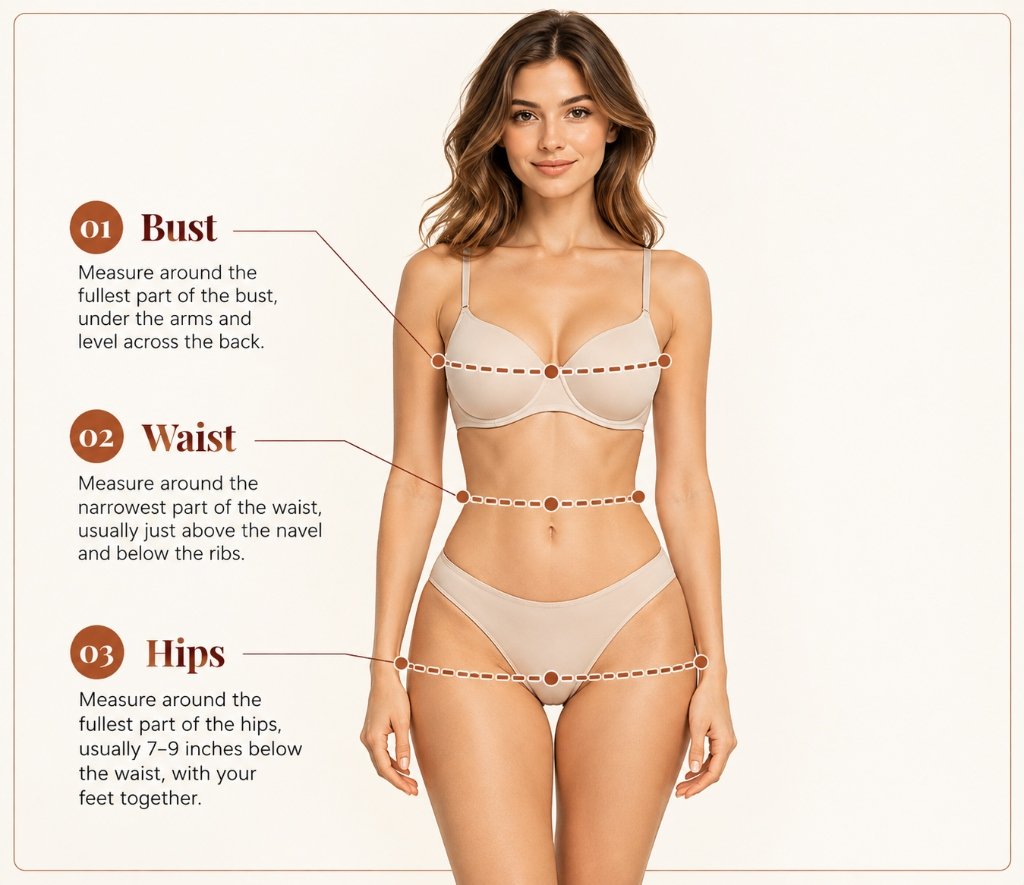
Measure the fullest part of the bust, the narrowest part of the waist, and the fullest part of the hips, standing relaxed, over close-fitting underwear and with the tape level all the way round.
Run the tape around the fullest part of the bust, under the arms and level across the back. Wear the bra you would normally wear under the garment, stand relaxed, and do not pull the tape tight.
Find the narrowest point, usually just above the navel and below the ribs. Bend sideways to locate the natural crease if you are not sure. Keep one finger under the tape.
Measure the fullest part, usually seven to nine inches below the waist, with your feet together. Check in a mirror that the tape is level behind you.
Write the three numbers down. Every tool on this site runs from them.
 BEFORE YOU CONVERT
How to Measure Yourself for the Right Size
01 Bust
02 Waist
03 Hips
METHODOLOGY
How This Converter Works
Most size charts appear online with no source and no date. This one should not be treated that way either, so here is what sits behind it.
What this clothing size converter is built on
The measurement ranges come from published international body-measurement conventions and the European size-labelling system, which define what body a given size number describes. Those are the same foundations national standards bodies use, and they are the reason a women’s size conversion chart can exist at all. We then cross-check every row against the published charts of the ten brands in the table above, and where a brand departs meaningfully from the standard we record the direction rather than averaging it away. Specifically, our conversion framework aligns with the EN 13402 European standard for garment size designation and ISO 8559 anthropometric standards. These standards establish baseline intervals of 4 cm across bust and hip circumferences for intermediate sizing bands, ensuring that conversions between national frameworks reflect documented manufacturing gradings rather than arbitrary retailer adjustments.
Why we ask for measurements rather than your usual size
A size label is a commercial decision. A measurement is a fact. Two garments labelled EU 38 from different houses can be cut for bodies a full size apart, so converting label to label compounds each brand’s drift. Converting from your body outwards removes one source of error entirely, which is why the measurement mode is the default. Body measurements remain stable regardless of which continent you purchase from, whereas brand sizing shifts according to demographic targets, customer feedback, and garment ease allowances. By calculating your base size directly from chest, waist, and seat dimensions, you establish a universal benchmark that translates cleanly across French, Italian, German, British, and American sizing tables without carrying forward retail vanity sizing distortions.
Where this converter is least reliable
Three situations. Heavily structured tailoring, where the armhole and shoulder matter more than the circumference. High-stretch fabric, where a smaller size is often the correct one. And bodies whose bust, waist and hip figures fall in three different size bands, which is extremely common — in that case the converter reports the range and tells you which measurement to prioritise for the garment type you are buying. In addition, outerwear designed with significant built-in ease and low-rise bottoms cut below the natural waistline introduce fit variables that pure circumference tables cannot fully capture.
If you want the history of how these systems diverged, Wikipedia maintains a neutral, well-sourced overview of clothing sizes that is more thorough than anything a retailer publishes. We update and verify our size data and brand deviation parameters each quarter to ensure continuous accuracy across changing seasonal collections.

Written & researched by Md Zubayer Al Hasan
Last reviewed September 2026
7 years in garment manufacturing · Sizing & grading specialist
QUESTIONS
Clothing Size Converter FAQ
- What is a US 6 in European sizes?
- A US 6 is an EU 38, a UK 10, an Italian 42 and a French 38. That corresponds to roughly a 35 inch bust, a 28 inch waist and a 38 inch hip. Individual brands vary by up to a full size in either direction.
- What is 42 in Italian size to US?
- An Italian 42 is a US 6. Italian sizes run four numbers above EU sizes, so an Italian 42 is also an EU 38 and a UK 10. Italian tailoring is cut narrower through the shoulder and waist, so consider sizing up for structured pieces.
- Are French and European sizes the same?
- The numbers are identical u2014 a French 38 and an EU 38 are the same label. The cut is not. French ready-to-wear is drafted narrower through the hip and shoulder and shorter in the sleeve than the German or Scandinavian equivalent.
- Why do European sizes use different numbers?
- EU sizes are derived from body measurements in centimetres, while US sizes descend from a 1950s statistical survey that has been repeatedly revised downward. The two systems were never aligned, which is why conversion requires a chart rather than a formula.
- Can I convert my size without measuring?
- Yes u2014 use the 'by known size' mode and enter a size you already own. It is less accurate than measuring, because it inherits whatever drift that brand applies, but it is a reasonable starting point.
- What if my bust, waist and hips are three different sizes?
- That is normal and the converter handles it. Buy for the largest of the three for fitted garments and have the rest taken in, since letting a seam out is harder. For dresses prioritise the bust, for trousers and skirts prioritise the hips.
- Do European brands run smaller than American ones?
- Often, but not uniformly. Spanish fast fashion runs small, Scandinavian labels run large and long, and Italian tailoring runs narrow rather than small. The brand table above records the direction for the labels most commonly ordered from the US.
- How do I convert centimetres to inches for sizing?
- Divide centimetres by 2.54. A 90 cm bust is roughly 35.4 inches. Every chart on this page lists both units, so no conversion is needed if you measure in centimetres.