
Size Guides
Size & Fit
Jeans Size Converter: US, EU, UK, Waist and W×L
Jeans are sized four different ways at once, which is why a jeans size converter has to do more than swap one number for another. There is the US number you see on the tab, the waist measurement in inches, the European number, and the W by L code that most denim brands actually cut to. This converter shows all four together, including the inseam that almost every chart leaves out. It also does something the brand charts will not: it tells you the difference between the number on the label and the waist that garment was really cut for, because in denim those two have drifted a long way apart.
Short answer: A US 6 is usually a 28 waist, an EU 38 and a W28. A US 8 is a 29 waist and an EU 40. Add roughly one to two inches to the number on the tab to get the waist the garment is actually cut for.
Free — no account
Nothing stored
Last reviewed September 2026
Jeans Size Converter: US, EU, UK, Waist and W×L Conversion Chart
Interactive converter requires JavaScript. You can view the full reference table below.
View Size Chart Below ↓Results are approximate and sizes vary by brand. Check the brand's own chart before buying — see our accuracy note.
FULL CHART
Women’s Jeans Size Chart: US, Waist, EU, UK and W×L
This women’s jeans size chart puts all four numbering systems in one place, which almost no chart does. Read the waist column as the body measurement the size is cut for, not as the number printed on the tab — those two have not matched for decades. The W column is the same figure expressed the way denim brands write it, so a W28 and a size 28 are the same garment described twice. The EU column runs on the standard European scale, and the UK column sits two numbers above the US one, as it does for every other garment.
Inseam Lengths (the L in W×L)
Measuring in centimetres? Every row gives both — a 71 cm waist is a 28, which is a US 6.
US 6 = W28 = EU 38
28 waist = 71 cm
UK 12 = US 8

THE PART NOBODY PUBLISHES
Why the Number on the Tab Is Not Your Waist
Short answer: A pair of jeans labelled 28 is usually cut for a waist of 29 to 30 inches. Vanity sizing has added one to two inches across most of the market, and more at the premium end. Measure yourself, then read the waist column rather than trusting the tab.
Here is an experiment worth doing. Take a tape measure to a pair of jeans you already own, measure straight across the waistband from side seam to side seam, and double it. Then compare that figure to the number printed on the tab. On most modern denim you will find a gap of one to two inches, and on premium labels it is often more. The tab is not lying, exactly — it is describing a size, not a measurement. But if you have ever measured a 28 inch waist, bought size 28 and found it loose, this is the entire explanation.
Vanity sizing has crept through the whole market over several decades, and denim has drifted further than almost any other garment because the number feels personal in a way that a letter does not. The practical consequence is that a waist size to jeans size conversion done by matching numbers will put most people one size too large. Our converter handles this by asking for your body measurement and returning the tab number that fits it, rather than assuming the two are the same thing.
Fabric adds a second layer. Rigid hundred per cent cotton denim will not give at all, so your exact waist measurement is the size to take. A blend with one or two per cent elastane will relax roughly half an inch after an hour of wear, which is why so many people size down in stretch denim and are right to. Anything above three per cent elastane behaves more like a legging than like jeans, and should be bought snug.
What the tab says
Size 28
What it is cut for
29 to 30 inch waist
Measure your body. Let the chart find the tab.
US / EU / UK
Jeans Size Conversion Between the US, Europe and the UK
Short answer: Add 32 to the US size for the European number and add 2 for the UK number. A US 6 is an EU 38 and a UK 10. A US 8 is an EU 40 and a UK 12. European denim also runs longer in the leg than American denim at the same size.
Jeans size conversion between the three main systems is arithmetic, at least on paper. The European number is the US number plus thirty-two, and the British number is the US number plus two. That holds across the whole range, so a us jeans size to eu conversion is the same addition whether you are a 2 or a 20, and going the other way is the same subtraction.
What the arithmetic does not capture is the cut. European denim is generally drafted for a longer leg and a slightly higher rise than the American equivalent, so an eu to us jeans size conversion that is numerically perfect can still arrive too long. Scandinavian labels are the most pronounced example. Going the other way, American denim frequently arrives short on European customers, which is why the inseam column matters more on this page than the waist one.
British sizing sits closest to American, and a uk to us jeans size conversion rarely surprises anyone. The one thing worth knowing is that British denim tends to be labelled in whole sizes only, where American brands often split the difference with odd waist numbers, so a conversion from UK will sometimes land between two US options. Take the smaller one in stretch denim and the larger one in rigid.
MEN’S → WOMEN’S
Men’s to Women’s Jeans Size Conversion
Short answer: Men’s jeans are labelled by waist in inches, women’s by a numeric size. Subtract 21 from the men’s waist to get the women’s size — a men’s 30 is roughly a women’s 9, so a women’s 8 or 10. The cut differs more than the number does.
A mens to womens jeans size conversion comes up more often than the charts suggest. Thrifted and vintage denim is mostly sold in men’s sizing, the boyfriend and dad fits that have been in rotation for years are cut on men’s blocks, and plenty of people simply find men’s denim better made at the same price. The arithmetic is straightforward: women’s numeric sizes run roughly twenty-one below the men’s waist measurement in inches.
The number is the easy part. Men’s jeans are drafted with a straighter hip-to-waist ratio, a lower rise at the back and a wider thigh, so a numerically correct conversion can fit at the waist and gape at the back or sit wide through the seat. If you are between options, take the smaller waist and accept the looser leg — a waistband can be taken in inexpensively, where a seat cannot be let out. Belt loops on men’s denim are also spaced for a wider belt, which is worth knowing before you assume something does not fit.
Going the other direction, a womens to mens jeans size conversion adds twenty-one back. A women’s 10 is roughly a men’s 31, which most brands round to a 30 or a 32. Length is the thing to check here rather than waist: men’s denim is cut for a longer inseam at every waist size, so the L number is doing more work than the W number.
Ranges appear where men's and women's scales do not line up evenly. Where two options are given, the smaller usually fits better in stretch denim.
Short answer:
Measure your natural waist where the jeans will actually sit, your hips at the fullest point, and your inseam from crotch to ankle bone. The waist gives the W, the inseam gives the L.
Find where the waistband will actually sit, which for most modern jeans is a couple of inches below the natural waist rather than on it. Keep the tape level and snug without compressing, and stand normally rather than holding your breath.
Measure the fullest point, usually seven to nine inches below the waist. If your hip measurement puts you two sizes above your waist measurement, buy for the hips and take the waistband in — that is a twenty minute job for any tailor and the most common jeans alteration there is.
Measure from the crotch seam down the inside of the leg to your ankle bone, in the shoes you intend to wear. Round down for a cropped look and up for a full-length one. This figure is the L in W×L, and it is the reason two people who wear the same size can have completely different experiences of the same jeans.
Write all three down. Every size tool on this site runs from them.
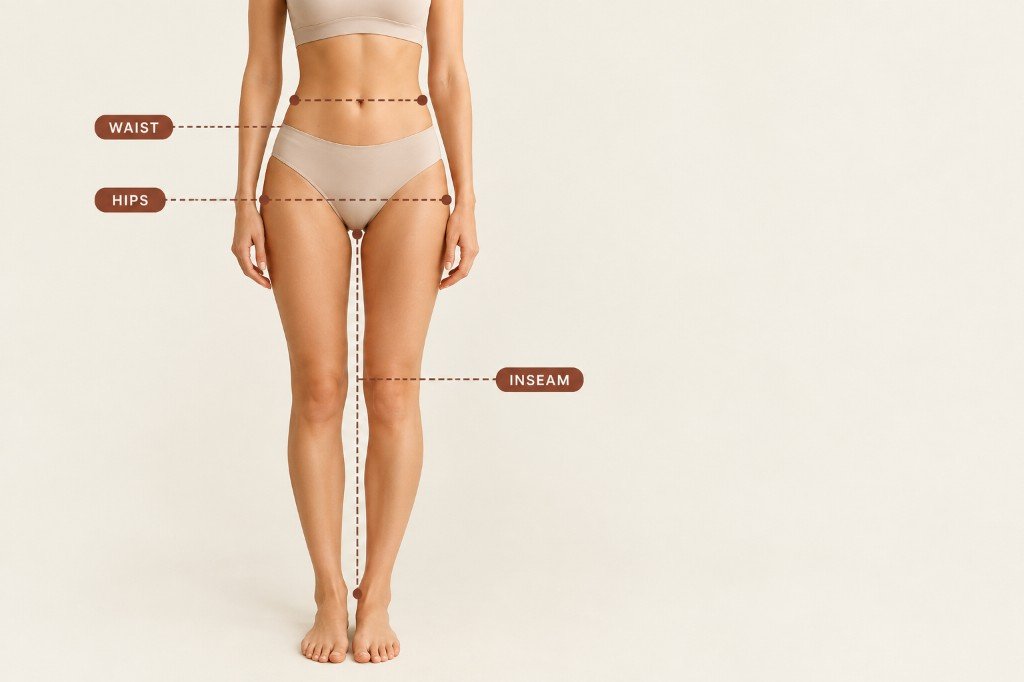 BEFORE YOU CONVERT
Waist Size to Jeans Size: How to Measure
01 Waist
02 Hips
03 Inseam
Short answer:
Premium denim generally runs small and rigid, mid-market denim runs true to the tab, and high street denim runs generous. Stretch content matters more than the label.
Every conversion on this page assumes a brand cuts to the standard. Denim brands vary more than almost any other category, because the number on the tab has become a positioning decision as much as a measurement. The table below records the direction of that drift for labels commonly bought across borders, alongside the stretch content that determines whether you should size down. It is compiled from published brand charts and returns patterns, and reviewed quarterly.
Reviewed quarterly. Last updated September 2026. Brands change fit blocks without announcing it — when a result falls between two sizes, the stretch content decides.
BRAND BY BRAND
Which Denim Brands Run Small, Large or True
HOW TO MEASURE
Measure Your Waist and Inseam
Step-by-step instructions to get the right numbers for jeans.
FIT TIPS
How Jeans Should Fit
A simple guide to rise, leg shape and the right length for your height.
STYLE GUIDE
Best Jeans for Your Body Shape
Find styles suited to your proportions, height and build.
METHODOLOGY
How This Converter Works
Almost every jeans size chart online belongs to a company selling denim, which means it describes that company’s cut and nothing else. This one is not selling anything, so here is what sits behind the numbers.
What this jeans size converter is built on
The waist and hip figures come from published body-measurement conventions rather than from any single brand’s chart, and the numeric US sizes are mapped to those measurements rather than to the tab numbers brands print. The European column follows the standard European scale, where the number is the US size plus thirty-two. The W figure is the same waist measurement expressed the way denim has always written it, and the L figure is a straight inseam measurement in inches. Each row is cross-checked against the published charts of the ten brands in the table above, and where a brand departs from the standard we record the direction rather than averaging it into the baseline.
Why the waist column and the tab number differ
Because they measure different things. The tab number is a size name; the waist column is the body it is cut for. Denim has drifted further from its own labels than any other garment category, typically by one to two inches and sometimes more at the premium end. A converter that treats the tab number as a measurement will send most people one size too large, so ours asks for your body measurement and returns the tab number that corresponds to it. If you would rather work from a size you already own, the second mode does that instead and says plainly that it inherits whatever drift that brand applies.
Where this converter is least reliable
Three situations. High-stretch denim above about three per cent elastane, which behaves closer to a legging and is usually bought a size down regardless of measurement. Bodies whose waist and hip measurements fall two or more sizes apart, where no single number is correct and the right answer is to buy for the hip and alter the waistband. And any fit with a dramatically different rise — a high-waisted style measures your natural waist while a low-rise measures several inches below it, so the same body produces two different numbers depending on where the garment sits. Our converter reports the range in all three cases rather than pretending to a precision it does not have.
For the history of how American numeric sizing became so detached from measurement, Wikipedia’s entry on US standard clothing size is the clearest neutral account available. For a single brand’s own measurements, Levi’s publishes one of the more transparent product size guides in the industry and is a useful reference point even if you never buy from them.

Written & researched by Md Zubayer Al Hasan
Last reviewed September 2026
7 years in garment manufacturing · Sizing & grading specialist
QUESTIONS
Jeans Size Converter FAQ
- What size jeans is a 28 waist?
- A 28 waist is a US size 6, an EU 38 and a UK 10, written as W28 on denim. Note that jeans labelled 28 are usually cut for a waist of 29 to 30 inches, so if you measure exactly 28 you may find the label size slightly loose.
- What is a US 6 in European jeans sizes?
- A US 6 is an EU 38 and a UK 10, with a waist of about 28 inches or 71 centimetres. Add 32 to any US size for the European number.
- What does W28 L30 mean?
- W is the waist in inches and L is the inseam in inches. W28 L30 means a 28 inch waist with a 30 inch inside leg, which suits most people between 5'3" and 5'5" in flat shoes.
- What men's size is a women's 10?
- A women's 10 is roughly a men's 31, which most brands round to a 30 or 32. The waist converts cleanly but the cut does not — men's denim is straighter through the hip and longer in the leg.
- Why do my jeans fit differently at the same size?
- Three reasons: stretch content, rise, and brand drift. A rigid pair and a two per cent elastane pair at the same size fit differently after an hour of wear, and a high-rise measures your waist where a low-rise measures your hip.
- Should I size down in stretch jeans?
- Usually, above about one per cent elastane. Stretch denim relaxes roughly half an inch during wear, so a snug fit at purchase becomes correct by the afternoon. Rigid cotton does not relax and should be bought to your measurement.
- What inseam do I need for my height?
- Roughly: under 5'3" takes an L28 to L30, 5'3" to 5'5" takes L30, 5'5" to 5'8" takes L32, 5'8" to 5'11" takes L34, and above that L36. Measure your own inseam in the shoes you will wear, since leg proportion varies at the same height.
- What if my waist and hips are different sizes?
- Buy for the hips and have the waistband taken in. It is the most common denim alteration, usually inexpensive, and far easier than letting out a seat. Curve-specific fits from several brands are cut for exactly this ratio.