
Dress Size Calculator: Everyday, Bridal and Prom
Most dress size calculators give you one number and stop. That number is fine for a high street dress and wrong for almost everything else, because dresses are sold on three separate scales. Everyday sizing is one. Bridal sizing is another, and it runs a size or two smaller than the number you normally wear. Formal and prom gowns run on a third, closer to bridal than to everyday. This calculator gives you all three from the same measurements, then tells you which of your three numbers matters most for the kind of dress you are actually buying — because a bodycon is decided by your hips and a fit-and-flare by your bust, and no single size can be right for both.
Short answer: A 35 inch bust, 28 inch waist and 38 inch hip is a US 6 in everyday sizing, a UK 10 and an EU 38. In bridal sizing the same measurements are usually a 8 or 10, because gowns are cut on an older, smaller scale.
Dress Size Calculator: Everyday, Bridal and Prom Conversion Chart
Interactive converter requires JavaScript. You can view the full reference table below.
View Size Chart Below ↓
This dress size chart gives the body measurements each size is cut for, not the finished garment — every dress is made with ease on top of these figures, and how much ease depends entirely on the cut. Read it as a starting point rather than a guarantee. The US column runs the familiar numeric scale, the UK column sits two numbers above it, the European column sits thirty-two above, and Italian sizing runs four above the European number. Both inches and centimetres are given on every row, so a dress size in cm is readable without converting anything first.
Bridal and prom dresses usually run smaller than everyday sizing, often by one or two sizes. Use this guide to find the equivalent size across the three systems for the same measurements.
Measuring in centimetres? Every row gives both — an 89 cm bust is a 35, which is a US 6.
Short answer:
Bridal sizing typically runs one to two sizes smaller than everyday sizing. Someone who wears a US 6 on the high street will usually order a bridal 8 or 10. Prom and formal gowns sit close to bridal. The number is a manufacturing convention, not a measurement of you.
If you have ever come out of a bridal appointment slightly winded by the number on the tag, this is why. Bridal houses never moved to the revised sizing that the rest of the clothing industry adopted over the past several decades. Where high street sizes have been quietly relabelled downward — the thing usually called vanity sizing — bridal held onto an older, smaller scale. The result is that two dresses cut for identical bodies carry different numbers depending on which side of that divide they were made. Nothing about you changed between the two shops.
Prom, pageant and formal gowns sit on the same older scale, or close to it, which is why a prom dress size chart looks more like a bridal one than like the chart from the shop where you buy jeans. Formalwear manufacturers and bridal manufacturers are frequently the same houses, and the patterns share a lineage.
There is a practical reason beyond history. Gowns are ordered months before they are worn and are always altered to fit, so the convention is to order to the largest of your three measurements and take the rest in. Bringing a seam in is routine; letting one out often is not possible at all, because there may be no fabric in the seam allowance to work with. That is also why a wedding dress size calculator should never give you a single confident number — it should give you the size your largest measurement falls into, and tell you which alteration is coming.
One more thing worth knowing before an appointment. Every bridal house publishes its own chart and they genuinely differ, sometimes by a full size between designers in the same shop. The chart below is a representative bridal scale, useful for knowing roughly where you will land and for not being caught off guard. When it comes to ordering, the designer's own chart is the only one that counts, and a good bridal consultant will measure you against it in front of you.
Representative scales only. Bridal and formal houses each publish their own chart and they differ meaningfully — always order against the designer's chart, not a general one. Reviewed September 2026.
Most bridal gowns are made to order and take six to eight months to arrive, plus six to eight weeks for alterations. Prom gowns are faster but sell out by size well before the season. Neither timeline leaves room for a size exchange, which is the real reason sizing up and altering down is standard practice.
Short answer:
Subtract 4 from a UK dress size to get the US size. A UK 10 is a US 6 and a UK 12 is a US 8. For Europe, subtract 32 — an EU 38 is a US 6. Italian sizes run four above European ones, so an Italian 42 is also a US 6.
Converting a uk dress size to us sizing is the most common cross-border question on this page, and it is a straight subtraction of four across the whole range. It holds whether you are a UK 6 or a UK 24. The confusion comes from the fact that the numbers look plausible in either system — a UK 12 and a US 12 are both ordinary sizes, so nothing about the label signals that you are reading the wrong scale.
European conversion is the same idea with a different constant. An eu dress size to us conversion subtracts thirty-two, and going the other way — us dress size to eu — adds it back. Germany, Spain, the Netherlands and Scandinavia all share this scale, and because it derives from body measurements in centimetres rather than from a retailer's own numbering, it tends to be the most consistent of the three. An italian dress size to us conversion needs one extra step: Italy runs four numbers above the European scale, so subtract four first and then thirty-two.
The arithmetic is reliable. The cut is not. European dresses are generally drafted for a longer torso and a narrower shoulder than American ones at the same nominal size, and Italian ready-to-wear is narrower again through the shoulder and upper arm. If you are ordering from a European label for the first time and your measurements sit between two sizes, the larger one is usually the safer choice for anything fitted.
Short answer:
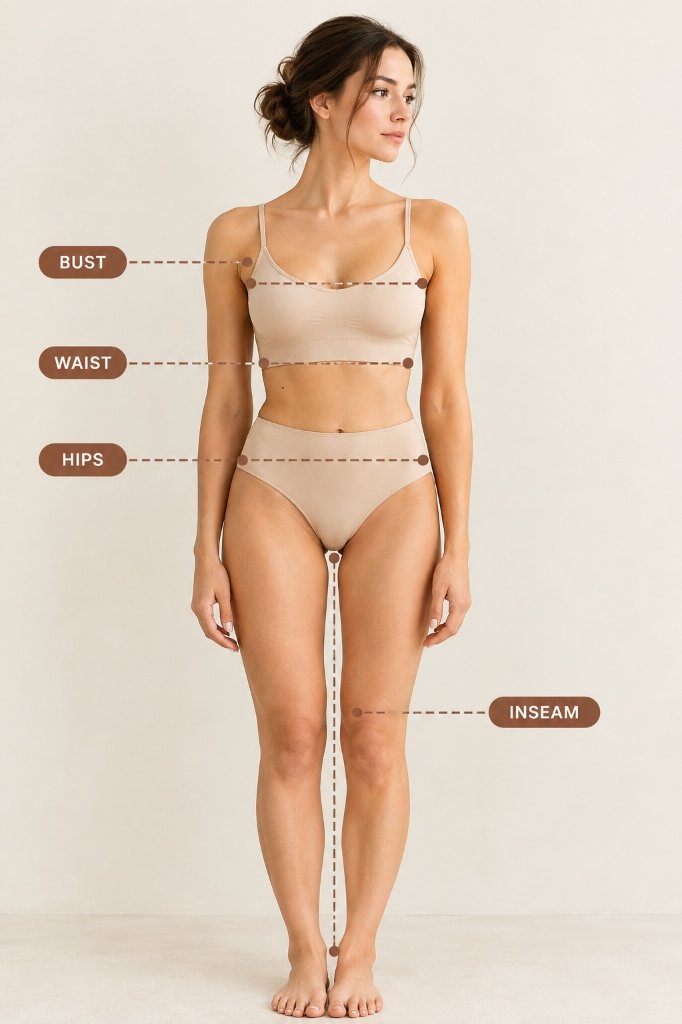
Measure the fullest part of the bust, the narrowest part of the waist and the fullest part of the hips, over close-fitting underwear with the tape level. Those three numbers are your dress size by measurements — the label on your last dress is not.
Run the tape around the fullest part, under the arms and level across the back. Wear the bra you intend to wear under the dress, since a different bra can change this figure by an inch or more. Stand relaxed and do not pull the tape tight.
Find the narrowest point, usually just above the navel and below the ribs. Bending to one side reveals the natural crease if you are unsure. Keep a finger's width under the tape rather than measuring flush.
Measure the fullest point, usually seven to nine inches below the waist, feet together. Check in a mirror that the tape is level behind you, which is where it most often slips.
Write all three down. Every size tool on this site runs from them, and none of them need to know your weight.
Short answer:
Hips decide bodycon and slip dresses. The bust decides fit-and-flare and wrap dresses. The largest measurement decides shifts, and ball gowns need both bust and waist. No dress is decided by all three equally.
Most dress size calculators take three measurements, find the size that fits the largest of them, and hand you a number. That is the safe answer, and for a structured dress it is the right one. But it will send you a size too large for a wrap dress and a size too small for a strapless gown, because different cuts load the fit onto different parts of the body. The table below is what our calculator uses when you select a dress type, and it is worth reading even if you never use the tool.
Where two measurements are given, size to whichever falls higher on the chart.
Short answer:
Fast fashion generally runs small, mid-market runs true, and several premium labels run generous. Formal and bridal labels run smaller than all of them.
Every number on this page assumes a brand cuts to the standard, and plenty do not. The table below records the direction of the drift for labels commonly ordered across borders, alongside the scale each uses. It is compiled from published brand charts and returns patterns, and reviewed quarterly. Once you have narrowed down a size, this table is more useful than any conversion chart.
Reviewed quarterly. Last updated September 2026. Brands change fit blocks without announcing it — when a result falls between two sizes, the dress type decides.
Step-by-step instructions for bust, waist and hips with tape placement photos.
How necklines, silhouettes and stretch determine which number decides your size.
When to size up, when to size down, and what a seamstress can realistically alter.
Dress sizing has less standardisation behind it than almost anything else you can buy, and most of the charts online belong either to a retailer describing its own cut or to a generic calculator with no fashion context at all. Here is what sits behind ours.
The measurement ranges come from published body-measurement conventions rather than from any single retailer's chart, and the numeric US sizes are mapped to those measurements. The UK column sits four numbers above the US one, the European column thirty-two above, and the Italian column four above the European. The bridal and formal scales are separate tables, built from the charts several bridal and formalwear houses publish, presented as a representative range rather than as a single authority — because in bridal there genuinely is no single authority. Every row is cross-checked against the ten brands in the table above, and where a brand departs meaningfully from the standard we record the direction rather than folding it into the baseline.
Because those two figures cannot produce a reliable dress size. Two people of identical height and weight routinely wear sizes three apart, since clothing is cut to the circumference of the bust, waist and hips rather than to mass or stature. A calculator that offers a size from height and weight alone is guessing, and it tends to guess in a direction that makes people feel worse rather than dress better. Two minutes with a tape measure beats it every time, and the tape does not care what the scale says.
Three situations. Bodies whose bust, waist and hip measurements fall in three different size bands, which is extremely common and is why we report a range and name the dress type rather than pretending to a single answer. Heavily structured garments — corseted bodices, boned gowns, tailored jackets — where the shoulder and armhole matter more than any circumference. And high-stretch fabric, where the correct size is often smaller than any measurement suggests. In all three, trying two sizes or asking a seamstress will beat a calculator, including this one.
For the history of how American numeric sizing drifted so far from measurement, Wikipedia's entry on US standard clothing size is the clearest neutral account available. For bridal specifically, The Knot's explanation of wedding dress sizes is a useful second opinion from outside the shops that sell the gowns.
Women's Dress Size Chart: US, UK, EU, Italian and French
US
UK
EU
ITALY
FRANCE
LETTER
BUST (in/cm)
WAIST (in/cm)
HIPS (in/cm)
0
4
32
36
32
XXS
31 / 79
24 / 61
34 / 86
2
6
34
38
34
XS
32 / 81
25 / 64
35 / 89
4
8
36
40
36
S
34 / 86
27 / 69
37 / 94
6
10
38
42
38
S
35 / 89
28 / 71
38 / 97
8
12
40
44
40
M
37 / 94
30 / 76
40 / 102
10
14
42
46
42
M
39 / 99
32 / 81
42 / 107
12
16
44
48
44
L
41 / 104
34 / 86
44 / 112
14
18
46
50
46
L
43 / 109
36 / 91
46 / 117
16
20
48
52
48
XL
45 / 114
38 / 97
48 / 122
18
22
50
54
50
XL
47 / 119
40 / 102
50 / 127
20
24
52
56
52
XXL
49 / 124
42 / 107
52 / 132
22
26
54
58
54
XXL
51 / 130
44 / 112
54 / 137
24
28
56
60
56
3XL
53 / 135
46 / 117
56 / 142
Bridal and Prom Size Guide
MEASUREMENT (bust/waist/hips)
EVERYDAY (US)
BRIDAL (US)
PROM (US)
EU
UK
32 / 25 / 35
2
0
0
34
6
34 / 27 / 37
4
2
2
36
8
35 / 28 / 38
6
4
4
38
10
37 / 30 / 40
8
6
6
40
12
39 / 32 / 42
10
8
8
42
14
41 / 34 / 44
12
10
10
44
16
43 / 36 / 46
14
12
12
46
18
Why Bridal and Prom Sizes Run Smaller
Bridal Size Chart (Representative)
BRIDAL SIZE
BUST (in)
WAIST (in)
HIPS (in)
USUAL EVERYDAY SIZE
2
32½
25
35½
US 0
4
33½
26
36½
US 0–2
6
34½
27
37½
US 2–4
8
35½
28
38½
US 4–6
10
36½
29
39½
US 6–8
12
38
30½
41
US 8–10
14
39½
32
42½
US 10–12
16
41
33½
44
US 12–14
18
43
35½
46
US 14–16
20
45
37½
48
US 16–18
Prom and Formal Sizing
PROM SIZE
BUST (in)
WAIST (in)
HIPS (in)
USUAL EVERYDAY SIZE
0
32
24½
35
US 0
2
33
25½
36
US 0–2
4
34
26½
37
US 2–4
6
35
27½
38
US 4
8
36
29
39½
US 6
10
37½
30½
41
US 8
12
39
32
42½
US 10
14
40½
33½
44
US 12
16
42
35
45½
US 14
Order early

UK Dress Size to US, and Other Conversions
US
UK
EU
ITALY
FRANCE
0
4
32
36
32
2
6
34
38
34
4
8
36
40
36
6
10
38
42
38
8
12
40
44
40
10
14
42
46
42
12
16
44
48
44
14
18
46
50
46
16
20
48
52
48
18
22
50
54
50
What Dress Size Am I? How to Measure
01 Bust
02 Waist
03 Hips
Which of Your Three Measurements Actually Decides the Size
DRESS TYPE
SIZE BY
IF YOU ARE BETWEEN SIZES
Bodycon or fitted
Hips
Take the larger; the waist can be taken in
Fit-and-flare
Bust
Take the larger; the skirt has room already
Shift or A-line
The largest of the three
Take the larger
Wrap
Bust, loosely
Either works; the tie adjusts the waist
Ball gown
Bust and waist
Take the larger; skirt volume hides the hip
Strapless or corseted
Bust and underbust
Take the smaller for support
Slip or bias-cut
Hips
Take the larger; bias fabric shows every seam
Which Dress Brands Run Small, Large or True
Get Accurate Measurements
Which Measurement Matters?
Between Sizes?
How This Calculator Works
What this dress size calculator is built on
Why we do not ask for your height or weight
Where this calculator is least reliable

Dress Size Calculator FAQ
- What dress size am I?
- Your dress size comes from three measurements: bust, waist and hips. A 35 inch bust, 28 inch waist and 38 inch hip is a US 6, a UK 10 and an EU 38. If your three measurements fall in different sizes, which one decides depends on the cut of the dress.
- Why is my wedding dress size bigger than my normal size?
- Because bridal sizing runs on an older, smaller scale that the rest of the industry moved away from decades ago. Someone who wears a US 6 on the high street usually orders a bridal 8 or 10. The number reflects a manufacturing convention, not a change in you.
- What is a UK 12 in US dress sizes?
- A UK 12 is a US 8 and an EU 40, cut for roughly a 37 inch bust, a 30 inch waist and a 40 inch hip. Subtract four from any UK size for the US equivalent.
- Can I find my dress size from my height and weight?
- Not reliably. Two people of the same height and weight can wear sizes three apart, because dresses are cut to bust, waist and hip measurements rather than to weight. A tape measure takes two minutes and is far more accurate than any height-and-weight estimate.
- What if my bust, waist and hips are three different sizes?
- That is normal, and which one decides depends on the dress. Size by the hips for a bodycon or slip, by the bust for a fit-and-flare or ball gown, and by whichever is largest for anything shift-shaped or structured. Then have the rest taken in.
- What size is an EU 40 dress in the US?
- An EU 40 is a US 8, a UK 12 and an Italian 44. European dresses are usually cut for a longer torso than American ones at the same size, so check the length as well as the size.
- Should I size up or down for a prom dress?
- Order to your largest measurement and have the rest altered. Formal gowns run smaller than everyday clothing, alterations bring a dress in easily, and letting a gown out is often impossible because there is no fabric in the seam to work with.
- Why do two dresses in the same size fit differently?
- Because the size is a label, not a measurement, and every brand applies its own fit block on top of it. Fabric matters too — a rigid woven and a stretch jersey in the same size behave completely differently on the same body.