
Inches to Ring Size Converter: Inches, Millimetres and Centimetres
This inches to ring size converter takes whichever measurement you actually have. Wrap a strip of paper around your finger and enter the length in inches, centimetres or millimetres. Measure a ring you already own and enter the inside diameter instead. Or, if you have nothing to measure with at all, print our sizer or use the on-screen ruler further down the page. Unlike most conversion charts, this one asks which measurement you took before it answers, because entering a diameter where a circumference belongs gives a result three times too small — and a resized ring costs considerably more than two minutes of care.
Short answer: A 2 inch circumference is roughly a US 5.5, 2.25 inches is a US 8, and 2.5 inches is a US 10.5. In millimetres, the European ring size is simply the circumference itself: 52 mm is an EU 52 and a US 6.
Inches to Ring Size Converter: Inches, Millimetres and Centimetres Conversion Chart
Interactive converter requires JavaScript. You can view the full reference table below.
View Size Chart Below ↓
Ring Size Chart: US, UK, EU, Circumference and Diameter
This ring size chart lists every system side by side, with both the inside circumference and the inside diameter for each size. Those two columns are the ones to read carefully. Circumference is the distance all the way around your finger, which is what you get from a paper strip. Diameter is the distance straight across the inside of a ring, which is what you get from a ruler laid across a ring you already own. They describe the same ring and differ by a factor of pi, so a diameter to ring size reading entered as a circumference will be badly wrong. The European column is worth noting too: an EU ring size is simply the circumference in millimetres, which makes it the most readable system of the three.
Measuring in centimetres? Divide by ten to read the millimetre column — 6.5 cm is 65 mm, which is a US 11.
Printable Ring Size Chart and On-Screen Sizer
Short answer: Print our paper sizer at 100% scale, check the calibration square with a ruler, then wrap the strip around your finger and read the size. If you have no printer, use the on-screen ruler and a bank card to calibrate the screen instead.
Search for a printable ring size chart and you will mostly download a jeweller’s PDF with no way to confirm it printed correctly. That is the flaw in every printed sizer: browsers and printers quietly rescale pages, and a strip printed at 94% will hand you a size that is a full size out. Ours carries a calibration square in the corner. Measure it with any ruler before you cut the strip, and if it is not exactly 50 millimetres across, set your printer to 100% or Actual Size and print again. The same problem applies on screen, which is why the on-screen version asks you to match a bank card — every card in the world is the same size, so it makes a reliable reference.
Printable Paper Sizer
Also available as a printable ring size chart with all systems.
On-Screen Ring Sizer
Works on phones and laptops. Nothing is uploaded.
UK Ring Size to US Conversion
Short answer: The UK uses letters, the US uses numbers, and they do not line up neatly. A UK L½ is a US 6, a UK N½ is a US 7, and a UK P½ is a US 8. Roughly, each US whole size is two letters plus a half in the UK alphabet.
Converting a uk ring size to us sizing is the one conversion on this page that cannot be done with arithmetic, because the two systems were built on different logic. American sizes are a numeric scale where each whole size adds about 2.55 millimetres of circumference. British sizes run through the alphabet in quarter-size letter steps, which is why the chart is full of half letters like J½ and R½. There is no formula — the chart is the answer.
This matters more than it sounds, because British, Irish and Australian jewellers all use the letter system, and Australia and New Zealand use the identical scale. If you are ordering from a British maker and the listing shows a letter, convert it here rather than guessing from the alphabet position. And if a size falls between two letters, British jewellers will generally cut the smaller of the two, where an American jeweller would round up.
EU Ring Size to US, and Other International Systems
Short answer: A European ring size is the inside circumference in millimetres. An EU 52 is a US 6, an EU 54 is a US 7, and an EU 57 is a US 8. Japan and China number their sizes on a separate scale of their own.
Converting an eu ring size to us sizing is the easiest job on this page, because the European number is not a code at all — it is the measurement. An EU 54 ring has an inside circumference of 54 millimetres. That makes any international ring size chart far more readable once you know it, and it means going the other way, us to eu ring size, is just a lookup of the circumference column above.
Germany, France, Italy, Spain and the Scandinavian countries all use this scale, sometimes written with a decimal such as 54.5. Japan runs a separate numeric sequence that looks similar to American sizing but is not — a Japanese 12 is a US 6 — and Chinese sizing follows the Japanese convention. Where a listing gives no system at all, the circumference in millimetres is the safest thing to ask the seller for.
Circumference or Diameter? Get This Wrong and You Are Three Sizes Out
Short answer: Circumference is around the finger. Diameter is straight across the inside of a ring. Circumference is roughly 3.14 times the diameter, so a 17 mm diameter and a 17 mm circumference are completely different rings — one is a US 7, the other does not exist.
Almost every wrong ring size starts here. A finger circumference to ring size conversion needs the distance all the way around, which you get from a paper strip or a tape. A diameter to ring size conversion needs the distance straight across the inside of a ring, which you get from a ruler laid across a ring you already own. Both are valid ways to find a size. Entering one where the other belongs is not.
You can usually catch the error by sanity-checking the number. Adult ring circumferences fall between roughly 44 and 70 millimetres, which is 1.7 to 2.75 inches. Adult inside diameters fall between roughly 14 and 22 millimetres. If your figure is around 17, it is a diameter. If it is around 54, it is a circumference. Our converter asks which one you took and refuses to guess, and it will tell you when a number lands somewhere no adult finger goes.
The other common error is measuring in the wrong place. The ring has to pass over your knuckle, so if your knuckle is noticeably wider than the base of your finger, measure both and choose something between the two — closer to the knuckle measurement for a snug band, closer to the base for a wide one. Measuring over the knuckle alone is why searches like three inches to ring size exist: that is a US 15 and a half, and almost nobody wears it.
Same ring. Two very different numbers.
How to Measure Your Ring Size at Home
Short answer: Wrap a strip of paper around the base of your finger, mark where it overlaps, and measure the length flat. That length is your circumference. Measure in the evening, at room temperature, and check the knuckle too.
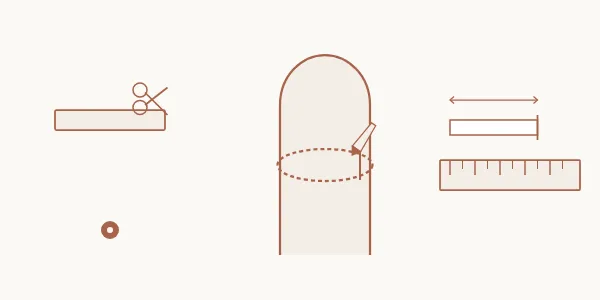
01 Cut a strip
Use paper rather than string, which stretches. A strip about a centimetre wide and ten centimetres long is enough. Ribbon, dental floss and thread all give readings that are too small.
02 Wrap and mark
Wrap it around the base of the finger, snug but not tight — you should be able to turn it. Mark the exact overlap point with a pen, then slide it off without letting it shift.
03 Measure flat
Lay the strip against a ruler and read the length to the mark. That figure is your circumference. Check it passes over your knuckle by wrapping the strip there too, and if the knuckle reading is much larger, size between the two.
Repeat twice on different occasions. Fingers change more than people expect.
Six Things That Change Your Ring Size
Time of day
Fingers are smallest in the morning and largest in the evening. Measure at both if you can.
Temperature
Cold shrinks, heat swells. A measurement taken outside in winter is not your size.
Band width
Wide bands sit tighter. Add a quarter to a half size for anything over six millimetres.
The knuckle
The ring has to pass it. A prominent knuckle usually means sizing between base and knuckle.
Dominant hand
It is often a quarter to a half size larger than the other.
Over time
Ring size drifts with age, weight and pregnancy. A size from five years ago is a starting point, not a fact.
How This Inches to Ring Size Converter Works
Nearly every ring size chart online belongs to a company that would like to sell you a ring. That does not make them wrong, but it does mean none of them explain where the numbers come from or where they stop being reliable. Here is both.
What this inches to ring size converter is built on
Ring sizes are one of the few garment-adjacent measurements with a genuine international standard behind them. The European and ISO scale defines a size as the inside circumference of the ring in millimetres, which is why an EU 54 measures 54 millimetres around. The American scale is numeric, starting near 44 millimetres and adding roughly 2.55 millimetres per whole size. The British scale runs through the alphabet in quarter-size letter steps and has no formula at all, so it is handled as a lookup. Every row in our chart is derived from those definitions and cross-checked against the published sizing pages of several international jewellers. Where the sources disagree, and they do at the half sizes, we give the ISO-consistent value and say so. Specifically, the International Organization for Standardization defines ring size designation in ISO 8653:2016 based on internal circumference measured in whole millimetres. Our mathematical conversion engine adheres to this standard, ensuring that millimeter readings translate directly into recognized European and international retail sizes without rounding bias.
Why we ask which measurement you took
Because the same number means two different rings depending on the answer. A circumference of 17 millimetres is not a size anyone wears; a diameter of 17 millimetres is a US 7. Most converters accept a bare number and hope, which produces confidently wrong results. Ours asks first, sanity-checks the figure against the range adult fingers actually occupy, and says plainly when a reading looks like it was taken across the finger rather than around it, or over the knuckle rather than at the base. Dimensional confusion between circular perimeter and diameter is responsible for the majority of jewellery returns. By establishing explicit input classification before executing the conversion formula, our tool guarantees that users do not inadvertently scale their ring by a factor of pi.
Where this converter is least reliable
Three situations. Wide bands, which sit tighter than a narrow ring of the same nominal size and usually need a quarter to a half size added. Prominent knuckles, where no single measurement is correct and the right answer is a compromise you have to choose. And any ring that cannot be resized later — full eternity bands, tension settings, some carved and inlaid designs — where the cost of being half a size out is the cost of the ring. For those, a jeweller’s steel sizing set is worth the trip, and any reputable shop will size your finger for free. Furthermore, physiological variables such as humidity, dietary sodium, circadian fluid retention, and seasonal temperature fluctuations can alter digital circumference by up to half a millimetre over twenty-four hours.
For the measurement conventions themselves, Wikipedia keeps a well-sourced overview of ring size systems including the ISO definition. For a buyer’s perspective on choosing a size for someone else, Blue Nile’s guide to finding your ring size is among the more thorough retailer explanations and is worth reading before a surprise purchase. You can consult Blue Nile’s guide to finding your ring size for practical purchasing insights.

Ring Size Converter FAQ
- What ring size is 2.5 inches?
- A circumference of 2.5 inches is 63.5 millimetres, which is a US 10½, a UK U½ and an EU 63. If you measured across a ring rather than around your finger, 2.5 inches would be a diameter, and no adult ring has an inside diameter that large.
- What ring size is 54 mm?
- A 54 millimetre circumference is a US 7, a UK N½ and an EU 54 — European sizes are the circumference itself. The corresponding inside diameter is about 17.3 millimetres.
- How do I convert cm to ring size?
- Multiply by ten to get millimetres, then read the circumference column. A 5.4 cm circumference is 54 mm, which is a US 7. A 6.5 cm circumference is 65 mm, which is a US 11.
- What is a UK L½ in US sizing?
- A UK L½ is a US 6, with an inside circumference of about 51.9 millimetres. British sizes move in quarter-size letter steps, so there is no formula — the chart above is the conversion.
- Is an EU ring size the same as the circumference?
- Yes. The European and ISO scale defines the size as the inside circumference in millimetres, so an EU 52 ring measures 52 millimetres around the inside. It is the most directly readable of the three systems.
- Should I size up for a wide band?
- Usually. Bands wider than about six millimetres cover more of the finger and sit tighter than a narrow ring of the same size. A quarter to a half size larger is the common adjustment, and more for bands over eight millimetres.
- How can I find someone's ring size without asking?
- Borrow a ring they already wear on that finger and measure the inside diameter, or trace the inside circle onto paper and measure across it. Note which finger it came from, since hands differ by up to a half size. Guessing from hand size alone is unreliable.
- Can any ring be resized?
- No. Plain metal bands resize easily, but full eternity bands, tension settings, and rings with channel-set stones or inlays often cannot be altered at all. For those, get sized professionally before ordering.