
European Style
Size & Fit
Bra Size Converter: US, UK, EU, Italian, French & Australian
This bra size converter does two things at once. It converts a size you already own between the six systems that actually differ from each other, and it checks whether that starting size was ever right. Most online calculators still add four or five inches to your underbust measurement — a habit left over from the 1950s, when band elastic barely stretched — which is the single most common reason a band rides up and a cup gapes. Enter a size to convert it, or enter your measurements and we will show you both what the old method gives and what your measurements actually say.
Short answer: A US 34C is a UK 34C, an EU 75C, a French 90C, an Italian 3C and an Australian 12C. Bands match between US and UK, but cup letters diverge above D: a UK 34DD is a US 34E, and a UK 34FF is a US 34H.
Free — no account
Nothing stored
Last reviewed September 2026
Bra Size Converter: US, UK, EU, Italian, French & Australian Conversion Chart
Interactive converter requires JavaScript. You can view the full reference table below.
View Size Chart Below ↓Results are approximate and sizes vary by brand. Check the brand's own chart before buying — see our accuracy note.
FULL CHART
Bra Size Conversion Chart: All Systems Side by Side
This bra size conversion chart covers the six systems that genuinely differ from one another. Band sizes are the simple half: US and UK bands are identical in inches, European bands are the underbust measurement in centimetres, French and Italian bands run on their own numbering, and Australian bands use dress-size numbers. The cup column is where conversion goes wrong, because UK and US cup letters stop agreeing above D. Both sequences are shown in full below rather than mapped to a single column, which is how most charts quietly introduce an error.
Band Size Conversion
Cup Size Conversion
US 34C = EU 75C
UK 34DD = US 34E
EU 80B = US 36B
UK → US
UK to US Bra Size Conversion
Short answer: Band numbers are identical — a UK 34 is a US 34. Cup letters are not. Up to D they match; after that UK runs DD, E, F, FF, G, GG while US runs DD, DDD, G, H, I. A UK 34DD is a US 34E and a UK 34FF is a US 34H.
UK to US bra size conversion is the conversion people get wrong most often, and the reason is deceptive. The band numbers are identical, so the first half of the size looks safe, and most shoppers assume the letter transfers too. It does not. The two systems agree up to a D cup and then diverge permanently, because the US inserted a DDD where the UK had simply carried on through the alphabet with doubled letters.
The practical consequence is that a woman who wears a UK 32F and buys a US 32F is buying a cup two sizes too small. The error compounds the larger the cup, which is exactly the range where fit matters most and where returns are most expensive. British and Irish brands all use the UK sequence, and they are precisely the brands American shoppers order from when they cannot find their size at home.
One more thing the charts rarely mention: UK brands generally cut a fuller, more projected cup at the same nominal volume, and their bands run firmer. If you are converting into a UK brand for the first time and the result falls between two sizes, take the smaller band and the larger cup rather than the other way round.
Most searched UK to US conversions
UK 34DD = US 34E
UK 34E = US 34DDD
UK 36F = US 36G
UK 34FF = US 34H
UK 34G = US 34I
UK 32GG = US 32J
EU → US
EU to US Bra Size Conversion
Short answer: Divide the European band by 2.54 to get your underbust in inches, then add 4 for the traditional US band. An EU 75 is a US 34 and an EU 80 is a US 36. Cups match to D, then European sizing continues E, F, G where the US inserts a DDD.
Converting an eu to us bra size is a two-part job, because the two systems describe different things. The European band is the underbust measurement in centimetres, rounded to the nearest five. The US band is that same measurement in inches, historically with four inches added. Once you know that, any european bra size chart becomes arithmetic: divide the EU band by 2.54, add four, and round to the nearest even number.
The cup letters are the harder half. European cups step up every two centimetres and run A, B, C, D, E, F, G with no doubled letters at all, so a European E is a US DD and a European F is a US DDD. German, Scandinavian and Dutch brands all use this scale. Going the other way — us to eu bra size — the same rules apply in reverse, though rounding means a US size can land between two European bands, in which case the smaller band is almost always the better fit.
IT / FR / AU / JP
International Bra Size Converter: France, Italy, Australia and Japan
Short answer: French bands are the EU band plus 15, Italian bands are a count from 1 to 7, Australian bands use dress-size numbers, and Japanese cups step every 2.5 cm rather than 2 cm. A US 34C is a French 90C, an Italian 3C, an Australian 12C and a Japanese 75C.
Beyond the US, UK and EU systems, four more are common enough to matter, which is why this international bra size converter covers them all. French sizing adds fifteen to the European band, so an EU 75 becomes a French 90 — the cups, usefully, are identical. Converting an italian bra size to us sizing means learning a short count instead: Italy numbers bands one through seven, where a 3 is a US 34.
Australian sizing borrows dress-size numbers, so an australian bra size to us conversion runs 12 to 34 and 14 to 36, with the cup letters following the UK sequence rather than the American one. Japanese sizing looks European but is not: an asian bra size conversion chart has to account for cups stepping every 2.5 centimetres instead of 2, which means Japanese cups run roughly one letter smaller than their European equivalent at the same nominal label.
THE PART NOBODY EXPLAINS
Why Most Bra Size Calculators Give You the Wrong Answer
Short answer: Older calculators add four or five inches to your underbust measurement before choosing a band. That habit dates from an era of stiff, barely elastic bands. Modern fitting uses the underbust measurement directly, which usually produces a smaller band and a larger cup letter for the same body.
If two calculators give you two different sizes, this is almost always why. The ‘+4 method’ was devised when band fabric had very little stretch and needed slack built into the number. Bra elastic has changed completely since, but the instruction survived in retailer size guides and in most of the free calculators online, because nobody wanted to be the first to tell customers their size had changed.
The difference is not subtle. A woman measuring 30 inches under the bust and 38 inches around the fullest part will be told she is a 34C by a +4 calculator and a 30G by a modern one. Those are the same volume of breast tissue — they are sister sizes — but only one of them has a band that will actually stay put. Because the band carries roughly eighty per cent of the support, a band that rides up is the source of most of what people blame on straps.
Our converter reports both. If you enter measurements, you will see the traditional result and the modern result side by side, with the difference explained, because plenty of brands still cut to the older convention and you may genuinely need the older number when ordering from them. What we will not do is show you one number and let you assume it is the only answer.
Historically, when early brassiere sizing conventions were standardized in the 1930s and 1940s, foundation garments were constructed from non-elastic woven cotton duck, rayon brocade, and heavy silk satins. Without synthetic elastane polymers, underbust bands offered negligible mechanical stretch. Pattern makers routinely drafted four to five inches of positive ease into the underband pattern to accommodate thoracic diaphragm expansion during inhalation without tearing garment seams.
Following the widespread introduction of spandex and synthetic elastic powernets in the late 1960s, foundations gained dramatic elongation and recovery properties, maintaining 30 to 45 percent stretch recovery under dynamic physiological loads. However, commercial retail size guides retained the legacy arithmetic, creating generations of poor fits where bands ride high across shoulder blades, underwires float forward, and straps painfully dig into the shoulders. Modern fitting methodology eliminates this structural defect by anchoring the band size directly to the snug ribcage measurement, restoring eighty percent of the foundational support to the torso where it belongs.
Traditional (+4)
Underbust 30in → band 34 → cup C → 34C
Modern (true underbust)
Underbust 30in → band 30 → cup G → 30G
Same volume. Different band. Only one of them stays down.
SISTER SIZES
Sister Sizes: The Same Cup, a Different Band
Short answer: Going down a band size means going up a cup letter to keep the same volume. A 34C, a 32D and a 36B all hold the same cup. Use this when your size is sold out or when a band feels loose.
Cup letters are not absolute volumes. A D cup on a 30 band and a D cup on a 38 band are very different garments, because the letter describes the difference between your underbust and your bust, not a fixed amount. This is why bra band size conversion and cup conversion cannot be done independently of each other.
Practically, it means every size has neighbours that hold the same volume. If the band feels loose, go down a band and up a cup. If the band digs in, go up a band and down a cup. This is also the fastest fix when a brand runs firm or loose, and it is the reason our converter shows sister sizes alongside every result.
32D
Down a band
34C
Your size
36B
Up a band
Short answer:
Cup shape varies as much as cup volume. British brands cut full and projected, several American brands cut shallow with looser bands, and European brands use the EU cup sequence rather than the US one.
Two bras labelled 34D from different houses can differ by a full cup in volume and by considerably more in shape. The table below records the direction of that drift for the brands most often ordered across borders. It is compiled from published brand charts and from fit-community reporting, reviewed quarterly, and it is more useful than any conversion chart once you have narrowed down a size.
Reviewed quarterly. Last updated September 2026. Brands change their patterns without announcing it — when a result falls between two sizes, buy both and return one.
BRAND BY BRAND
Which Bra Brands Run Firm, Loose or Shallow
Short answer:
Measure snugly under the bust for the band, then loosely around the fullest part for the bust. The difference in inches gives the cup letter — one inch is an A, two a B, three a C, and so on.
Stand upright and run the tape directly under the bust, level all the way round and pulled snug — firmer than you would measure anywhere else, because this is the measurement the band has to match. Exhale and take the reading.
Measure loosely around the fullest part, usually across the nipple line, with the tape level at the back and no compression at all. Lean forward slightly if it helps the tissue sit naturally, then stand and read.
Subtract the underbust from the bust. Each inch of difference is one cup letter. A four-inch difference is a D in every system; which letter that is called depends on whether you are buying in the UK, the US or Europe.
Measuring in centimetres works the same way — use a cm to bra size converter step, or divide by 2.54 first.
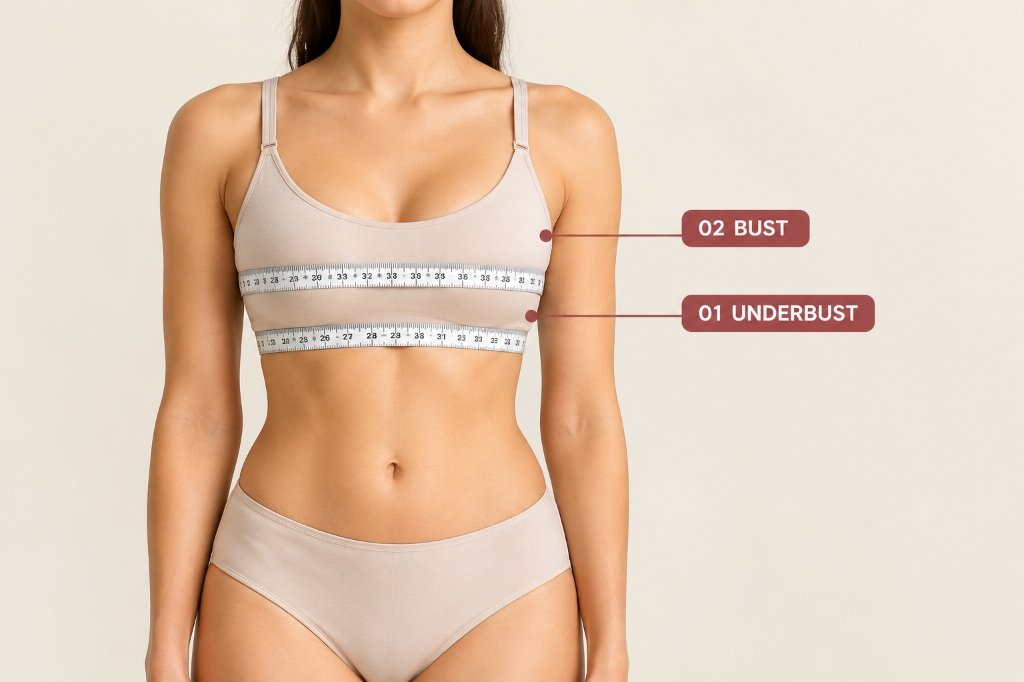 BEFORE YOU CONVERT
How to Measure for a Bra Size
01 Underbust
02 Bust
03 The difference
METHODOLOGY
How This Converter Works
Bra sizing carries more folklore than any other measurement on this site, so it matters where the numbers come from.
What this bra size converter is built on
Band conversions follow the underlying definitions each system uses: US and UK bands in inches, European bands as the underbust measurement in centimetres rounded to the nearest five, French bands as the European band plus fifteen, Italian bands as a sequential count, Australian bands on the dress-size scale, and Japanese bands on the European scale with a 2.5 cm cup step. Cup letters are mapped sequence to sequence rather than letter to letter, which is the only way to convert correctly above a D. Our computational matrix draws upon international anthropometric benchmarks including ISO 8559-1 standards and EN 13402 European sizing frameworks. By calculating the physical breast root circumference against the underband tension gradient, the tool provides consistent grading across all six manufacturing systems.
Why we show two results from measurements
Because the industry has not settled on one. The traditional method adds four inches to the underbust before choosing a band; the modern method does not. Many brands still cut to the older convention, so hiding one of the two answers would make the tool wrong for whichever brand you happen to be buying. We show both, label them clearly, and explain which is likely to fit better. Showing both methods empowers shoppers to select the exact sizing philosophy that aligns with the specific label they intend to purchase, bridging the gap between heritage department store sizing and specialized European fuller-bust manufacturing.
Where this converter is least reliable
Three situations. Cup volume above a UK G, where brand shape matters far more than the label. Bodies where the underbust measurement falls exactly between two bands, which is common and usually resolved by the firmness of the specific band. And any brand using half-cup or custom sizing, where a published conversion simply does not apply. In all three, a professional fitting or trying two sister sizes will beat any calculator, including this one. Furthermore, breast tissue density, root width, projection, and asymmetry are volumetric factors that linear two-dimensional circumference measurements cannot capture alone.
For the measurement conventions themselves, Wikipedia keeps a well-sourced overview of bra size systems. For fit methodology, the A Bra That Fits calculator is the most widely used non-commercial tool built on the modern method, and worth running alongside this one.

Written & researched by Md Zubayer Al Hasan
Last reviewed September 2026
7 years in garment manufacturing · Sizing & grading specialist
QUESTIONS
Bra Size Converter FAQ
- What is a US 34C in European sizes?
- A US 34C is a European 75C, a French 90C, an Italian 3C and an Australian 12C. The UK equivalent is also 34C, since the two systems agree up to a D cup.
- What is a UK 34DD in US sizing?
- A UK 34DD is a US 34E. The band is identical, but the cup sequences diverge above D u2014 UK runs DD, E, F, FF, G while US runs DD, DDD, G, H. Buying a US DD when you wear a UK DD is correct; buying a US F when you wear a UK F is not.
- Why do UK and US cup letters stop matching?
- The US inserted a DDD between DD and the next letter, while the UK continued with doubled letters instead. The two sequences agree through D, then drift by one position and never realign. Any chart that maps them letter for letter above D is wrong.
- Is 80B the same as 36B?
- Yes. An EU 80B is a US and UK 36B. The European band is the underbust in centimetres, so 80 cm corresponds to roughly 31.5 inches measured, which becomes a 36 band under the traditional method. Cup letters match at B in both systems.
- What are sister sizes?
- Sizes that hold the same cup volume on a different band. A 34C, a 32D and a 36B are sister sizes. Going down a band means going up a cup letter, and vice versa. Use them when your size is sold out or when a band feels loose but the cup fits.
- Can I find my bra size from my bust measurement alone?
- No. The bust measurement gives you nothing on its own u2014 the size comes from the difference between your underbust and your bust. Without the underbust figure there is no band and no cup. Any tool asking only for bust is guessing.
- Why do two calculators give me different sizes?
- Almost always because one adds four inches to the underbust measurement and the other does not. Both answers are usually sister sizes of each other, so the cup volume is the same; what differs is the band, and the smaller band is generally the one that stays put.
- Do European bras run smaller than American ones?
- Not smaller, but shaped differently and more consistently. European brands use the EU cup sequence with no doubled letters, and their bands tend to be cut firmer. Converting the label correctly matters more here than adjusting for size.