Between Sizes? What to Do, Garment by Garment

Almost everyone is between sizes in something. Bodies do not follow size charts, charts differ between brands, and one measurement often lands in one size while another lands in the next. The question is not how to avoid it but what to do about it — and the answer is different for a coat, a pair of jeans, a ring and a hat.

This guide gives a practical rule for each, based on one principle: choose the size that can be adjusted to fit, not the one that cannot. More in our Size Guides section.

When in doubt, choose the size that fits the part of the garment that cannot be altered — usually the larger size — and have the rest taken in. Taking in is easy; letting out rarely is.

Why You Are Between Sizes

Size charts give a range for each size, and most people’s bust, waist and hip do not all fall in the same one. Add brand variation — the same number can differ by several centimetres from one label to the next — and landing on the line between two sizes is normal rather than unusual.

The first step is always to measure rather than rely on a remembered size. The clothing size converter works from your measurements and shows how brands compare.

The General Rule

Garments can be taken in far more easily than they can be let out, because letting out needs spare fabric in the seams, and most modern clothes have very little. So the larger size is usually the safer choice — as long as the part that cannot be altered still fits.

The parts that cannot easily be altered are the ones to fit first: the shoulders of a jacket or coat, the length of a sleeve on some styles, and the hip of a fitted skirt. Get those right and the rest can be adjusted.

Garment by Garment

GarmentIf between sizesWhy
Coats and jacketsFit the shoulderThe shoulder cannot be altered well
Fitted dressesLarger size, take inMust fit the largest measurement
Wrap dressesFit the bustThe waist adjusts with the tie
TrousersFit the hip, take in the waistWaist take-ins are routine
Rigid jeansSmaller, if only slightly snugRigid denim gives a little with wear
Stretch jeansThe size that fits nowStretch relaxes, never tightens
KnitwearBy preferred fitKnits can stretch but not shrink back evenly
Leather glovesSmaller, if only slightly snugLeather stretches to the hand
HatsLarger, with a sizing insertA hat can be made smaller, not larger
RingsLargerEasier to size down than up

Coats and Jackets

The shoulder decides. A jacket too narrow in the shoulder pulls across the back and cannot be fixed; one slightly generous in the body can be taken in. See how to choose a trench coat for the shoulder test.

Dresses

Size by the measurement the shape depends on. A fitted sheath needs the largest of your three measurements; a wrap dress needs the bust. Dress types and how they fit covers every shape, and the dress size calculator tells you which measurement is deciding.

Trousers and Jeans

Fit the hip and seat, then have the waist taken in if it gaps. Rigid and stretch denim behave differently — read how jeans should fit and use the jeans size converter.

Hats

Choose the larger size. A hat that is slightly big can be made to fit with a sizing insert or hat tape; one that is too small is uncomfortable and much harder to stretch. See how a hat should fit and the hat size calculator.

Gloves

Leather gloves stretch slightly to the hand with wear, so if you are between sizes and the smaller one is only a little snug, it usually becomes the better fit. Wool and knit gloves do not work the same way. The glove size calculator explains the difference.

Rings

Size up. A ring slightly too large can be sized down or fitted with an insert; one too small can only be stretched so far. See how to find a ring size and the ring size converter.
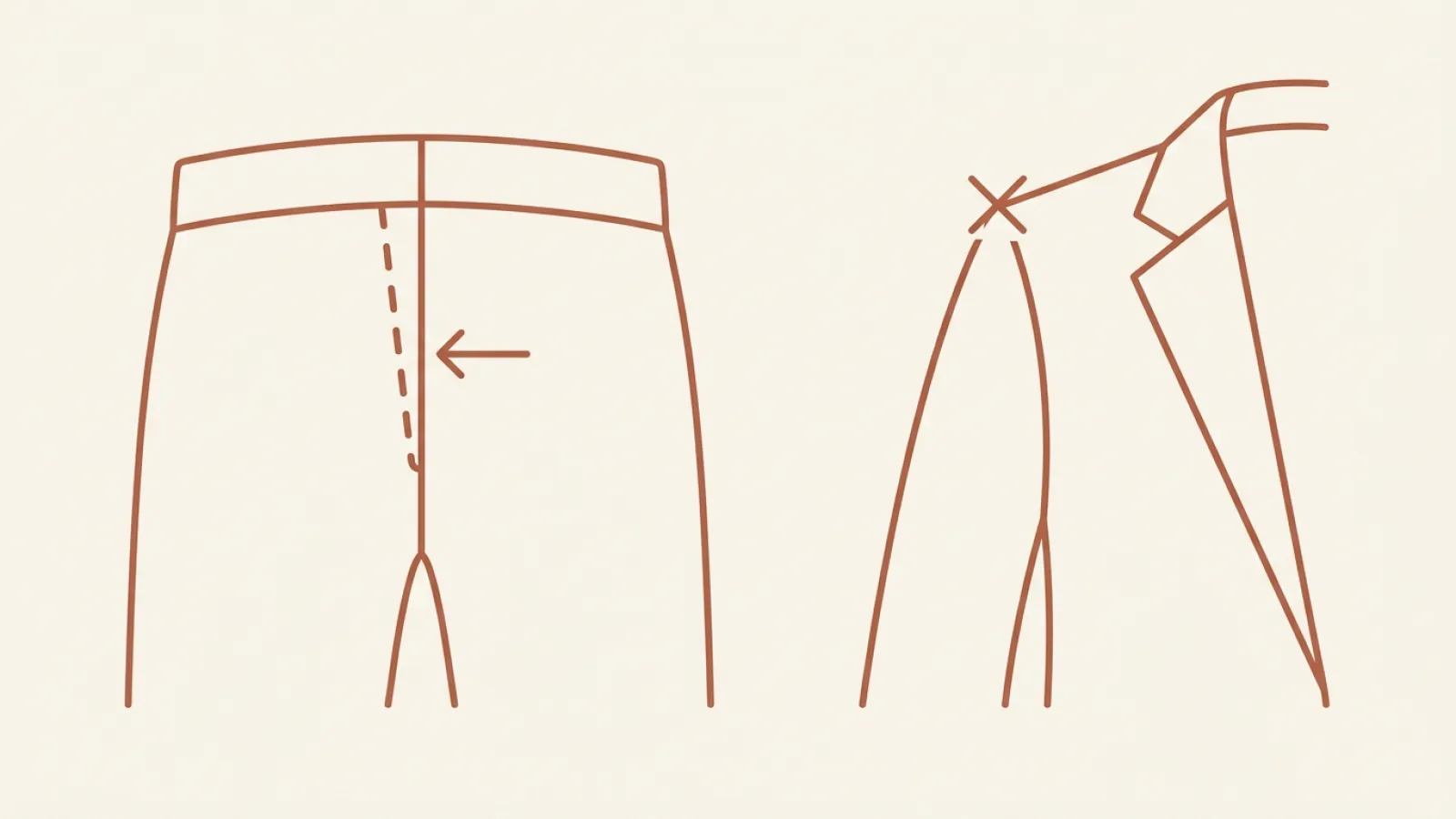
Line drawing showing a trouser waist that can be taken in and a jacket shoulder that cannot be altered.

When Alterations Make Sense

Hemming, taking in a waist and shortening straps are quick, inexpensive and routine. Taking in the side seams of a dress is common. Altering shoulders, letting out anything significantly, or reshaping a heavily structured garment is expensive and not always possible.

Include the alteration cost when deciding whether a piece is worth it — the cost per wear calculator has a field for it, and it rarely changes the answer.

If you are regularly between sizes in the same way — a smaller waist relative to the hip, for example — look for brands and cuts designed for that proportion. The body shape calculator tells you which proportion you are.

Frequently Asked Questions

Should I size up or down if I am between sizes?

Usually up, and have the rest taken in — as long as the part that cannot be altered, such as a jacket’s shoulders, still fits.

What if my bust and hips are different sizes?

That is normal. Size by the measurement the garment depends on most — the bust for a wrap dress, the hip for trousers, the largest for a fitted dress.

Should I size down in stretch fabrics?

Take the size that fits comfortably now. Stretch fabrics relax with wear, so a size that already feels loose will only get looser.

Is it better to size up in coats?

Only if the shoulder still fits. A coat that is too wide in the shoulder looks borrowed and cannot be fixed.

What do I do if I am between ring sizes?

Choose the larger size. It can be sized down or fitted with an insert far more easily than a small ring can be enlarged.

For how European sizes are built on body measurements, see EN 13402, and for how garments are adjusted after purchase, alterations.

How to Find Her Ring Size Without Asking: Six Reliable Methods

Buying a ring as a surprise creates a small practical problem: you need a measurement from someone you cannot ask. The good news is that it is solvable, and several of the methods below are far more accurate than guessing. The better news is that ring sizing is forgiving in one direction — so even a method that gets you close is usually enough.

The methods for how to find a ring size without asking are ranked by how accurate they tend to be. Use the highest one available to you, and read the section on sizing up before you buy. For more sizing guides, see our Size Guides section.

Borrowing a ring she already wears on the right finger is the most reliable method. If you have to guess, guess slightly large — a ring that is too big is usually easier to adjust than one that is too small.

Six Ways to Find a Ring Size Without Asking

1. Borrow a Ring She Already Wears

Take one she wears on the same finger, ideally the same hand, and either take it to a jeweller or measure its inside diameter yourself. Return it before it is missed.

Accuracy: high, if it is worn on the same finger.

2. Measure the Inside Diameter of a Ring

Lay a ruler with millimetre markings across the inside of the ring at its widest point, from inner edge to inner edge. That number converts directly to a ring size.

Accuracy: good, if you measure carefully. Half a millimetre is roughly half a ring size, so take the reading twice.

3. Press a Ring Into Soap or Wax

Press the ring into a bar of soap or a piece of softened wax to leave a clean impression of its inner circle, which a jeweller can read.

Accuracy: good.

4. Ask a Friend or Family Member

Someone close may already know her size, or can find out naturally — trying on rings together is an easy excuse.

Accuracy: depends entirely on the source.

5. Compare Against Your Own Fingers

Slide one of her rings onto your own fingers and note exactly where it stops. A jeweller can size that finger for you afterwards.

Accuracy: fair, and much better than guessing.

6. Estimate From General Hand Size

The least reliable method, and one to use only when nothing else is possible.

Accuracy: low. Use the size-up rule below.

A ring worn on a different finger or hand will not give the right size. Fingers differ, and the dominant hand is often slightly larger. Tracing the outline of a ring on paper gives an accurate size. Tracing adds the width of the pencil line and follows the ring unevenly, which can easily move the result by half a size or more. Measuring the inside diameter with a ruler is far more reliable.

Measuring a Finger Directly

If you ever do get the chance to measure her finger — or you are measuring your own — the string or paper method is quick and needs nothing special. Wrap a thin strip of paper around the base of the finger, mark where it overlaps, and measure the length in millimetres. That is the circumference, which converts to a ring size.

Things That Change a Ring Size

  • Temperature — fingers are smaller in the cold and larger in the heat
  • Time of day — fingers tend to be slightly larger later in the day
  • Which hand — the dominant hand is often slightly larger
  • Knuckles — a ring has to pass over the knuckle; a large knuckle and a slim finger need a size that clears one and does not spin on the other
  • Band width — a wide band fits more snugly than a thin one in the same size

Converting What You Have Into a Size

Ring sizes are expressed differently around the world. The US uses numbers, the UK uses letters, and much of Europe uses the inside circumference in millimetres. The same ring can carry three different labels depending on where it is sold, which is why converting before ordering matters.

Enter the inside diameter from a borrowed ring, or a circumference from a paper strip, and the converter gives the size in every major system. There is also a printable sizer if you can borrow a ring for a minute.

When You Are Not Sure: Size Up

A ring that is slightly large can often be sized down, or fitted with a small sizing insert. A ring that is too small can only be sized up so far, depending on the metal and the design.

Rings with stones set all the way round — eternity bands — often cannot be resized at all, so accuracy matters most for those. If you are buying one of these and are not confident of the size, a plainer design may be the safer surprise.

Ask about the jeweller’s resizing policy before buying. Many resize once at no charge, which takes most of the risk out of an estimate.

If the ring is gold or silver, our guide to gold or silver for your undertone helps you choose the metal, and European jewellery brands worth knowing covers where to look. Planning a wedding? See wedding dress shopping: what to expect. And if she is between two ring sizes, the same logic as clothing applies — see what to do between sizes.

Choosing the Ring as Well as the Size

Once the size is settled, the metal and the style matter as much. The undertone test helps decide between gold and silver, and the colour analysis quiz shows which stone colours sit best with her colouring. For earrings or a matching set, earrings by face shape covers proportion, and the face shape detector works it out from measurements.

If you are buying gloves as part of a winter gift, the same measure-first approach applies — the glove size calculator works from a hand measurement.

Frequently Asked Questions

How can I find her ring size without asking?

Borrow a ring she wears on the same finger and measure its inside diameter, or have a jeweller size it. Both are accurate enough to buy from.

Should I size up or down if I am unsure?

Up. A ring that is slightly large is usually easier to adjust than one that is too small.

Can any ring be resized?

Most plain metal bands can be resized within a size or two. Eternity bands with stones all the way round often cannot.

Is ring size the same on both hands?

Often not. The dominant hand is frequently slightly larger, so borrow a ring from the same hand if you can.

Is tracing a ring on paper accurate?

Not very. The pencil line adds width and the outline is rarely even. Measure the inside diameter with a ruler instead.

For background on how ring size systems differ between countries, see ring size, and for independent guidance on buying rings, the Gemological Institute of America.