Haircuts by Face Shape: Length, Layers and Where the Volume Sits

A haircut changes the shape that frames the face more than any accessory can, which is why choosing haircuts by face shape is worth a few minutes before an appointment. The principles are the same as for glasses and earrings: contrast, and attention to where width and length sit. The tools are different: length, layers, a fringe, and where the volume is placed.

This guide applies those principles to the six face shapes. It is about proportion, not about changing how a face looks, and your hair’s texture and your stylist’s judgement matter as much as any table. More in our Body Shape Styling section.

Place volume where the face is narrowest and length where it adds contrast. Longer faces suit fringes and volume at the sides; rounder faces suit length past the chin and height at the crown.

If you are not sure of your face shape, the detector works from four measurements, a short quiz, or a photo processed on your device.

Four Tools a Haircut Uses

Length

Where the hair ends sets a horizontal line. Length at the chin emphasises the jaw; length past the chin draws the eye downward.

Layers

Layers add movement and control where volume sits. Layers around the face soften; long layers add movement without width.

Fringe

A fringe shortens the visible length of the face and frames the eyes. Straight, side-swept and curtain fringes each do this differently.

Volume Placement

Volume at the crown adds height; volume at the sides adds width. Choosing where it goes is the most powerful adjustment of the four.
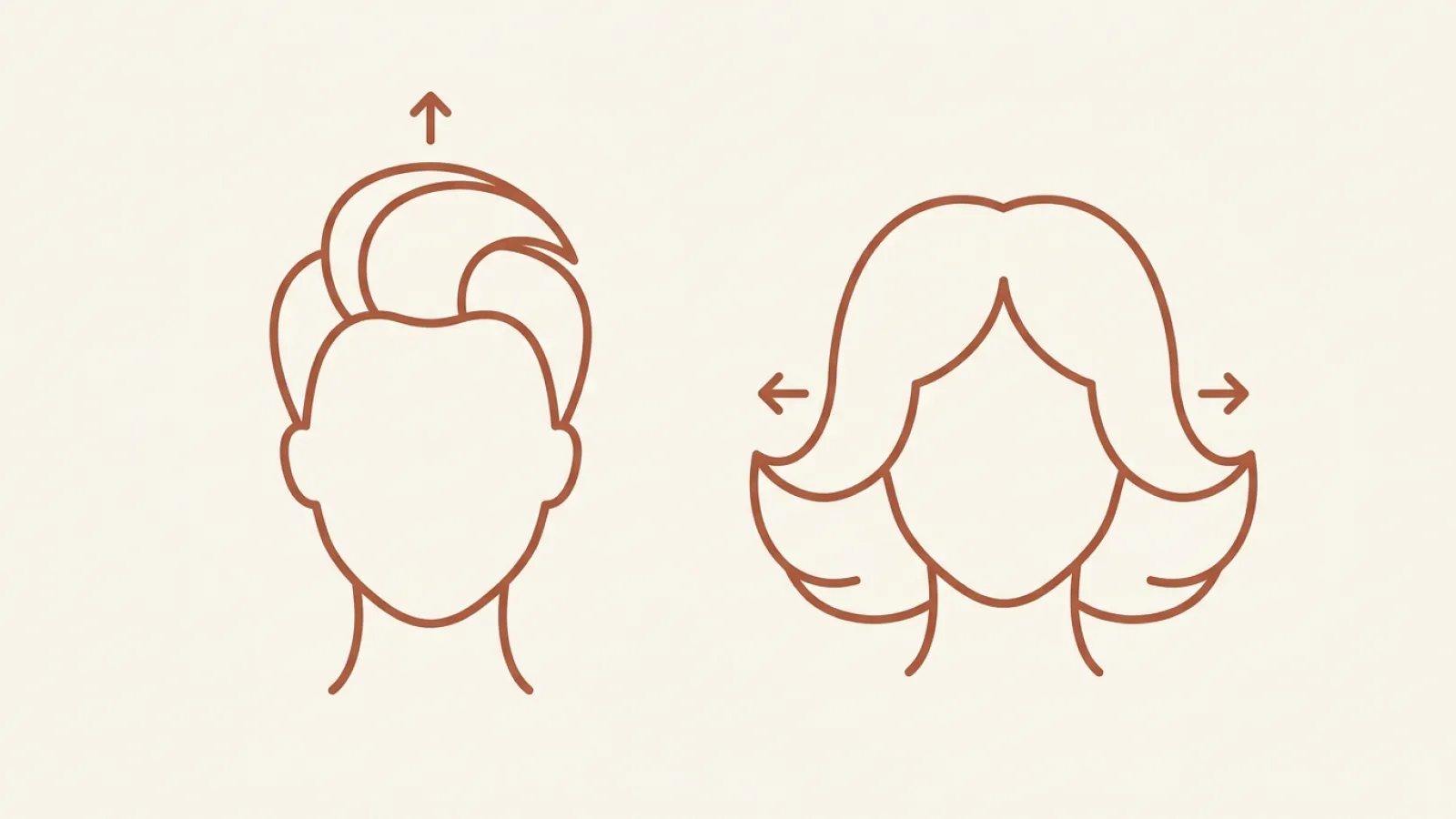
Line drawing of two hairstyles: one with volume at the crown, one with volume at the sides.

Haircuts for Each Face Shape

Oval

Most cuts work, from pixie to long. Choose by texture and preference. Read more about the oval face shape.

Round

Length past the chin, height at the crown, and a side part or side-swept fringe add vertical lines. Long layers work well. Read more about the round face shape.

Square

Soft layers, waves and a side part soften a strong jaw. Length past the jaw, or a textured bob that ends just above or below it, works well. Read more about the square face shape.

Heart

Chin-length bobs and volume at the jaw add width where the face is narrowest. Side-swept or curtain fringes suit a wider forehead. Read more about the heart face shape.

Diamond

A fringe adds width at the forehead, and volume at the chin adds width at the jaw, both narrower than the cheekbones. Chin-length cuts work well. Read more about the diamond face shape.

Oblong

A fringe shortens the visible length; volume and waves at the sides add width. Shoulder-length or shorter usually works better than very long and straight. Read more about the oblong face shape.

Face shapeLengthVolumeFringe
OvalAnyAnyAny
RoundPast the chinAt the crownSide-swept
SquarePast or just off the jawSoft, around the faceSoft, side-swept
HeartChin lengthAt the jawSide-swept or curtain
DiamondChin lengthAt forehead and chinFull or side-swept
OblongShoulder or shorterAt the sidesFull or curtain
Hair texture changes everything. Very curly, very fine and very thick hair each behave differently from the same cut, so bring these principles to a stylist rather than treating them as instructions. Take this table, and a photo of the proportion you like rather than a specific celebrity cut, to your appointment. It gives the stylist the idea without asking them to copy someone with different hair.

Colour as Well as Cut

A new colour can shift which clothing colours suit you as much as a new cut shifts your proportions. Read hair colour by colour season before a big change, and retake the colour analysis quiz afterwards.

With Glasses, Earrings and Hats

Your haircut, glasses, earrings and hats all frame the face together, and a change in one can change what works in the others. See glasses for your face shape, earrings by face shape and the best hats for your face shape. For the rest of your look, the personal style quiz helps keep it consistent.

Frequently Asked Questions

How do I choose a haircut for my face shape?

Place volume where the face is narrowest and choose a length that adds contrast. Then adjust for your hair’s texture with your stylist.

What haircut suits a round face?

Length past the chin, height at the crown and a side part or side-swept fringe.

What haircut suits an oblong face?

A fringe to shorten the visible length and volume at the sides, usually shoulder-length or shorter.

Do fringes suit every face shape?

Most shapes can wear some kind of fringe. Side-swept and curtain fringes are the most adaptable.

Does hair texture change what suits me?

Yes, a great deal. The same cut behaves very differently in curly, fine and thick hair, so discuss it with a stylist.
For background, see hairstyle and fringe.

Earrings by Face Shape: Which Styles Work and Why

Earrings sit at the jaw, which makes them one of the most effective ways to change how an outfit frames the face. Choosing earrings by face shape follows the same principle as glasses and hats — contrast — applied to three details: how long the earring is, how wide it is, and whether its shape is curved or angular.

This guide applies that principle to the six face shapes. It is about proportion, not about changing how a face looks, and preference always outranks the table. More in our Body Shape Styling section.

Contrast the face: longer, linear earrings suit rounder faces; rounded and wider earrings suit angular and longer faces. Studs work on everyone.

If you are not sure of your face shape, the detector works from measurements, a quiz, or an on-device photo.

Three Details That Decide It

Length

A long drop adds a vertical line; a stud or short hoop keeps things compact. Longer faces tend to suit shorter earrings, and shorter faces longer ones.

Width

Wide earrings — large hoops, chandeliers, clusters — add width at the jaw. They work best where the jaw is narrower than the forehead or cheekbones.

Shape

Curved earrings soften angular features; angular or linear earrings add definition to softly curved ones.

Earrings for Each Face Shape

Oval

Almost every style works. This is the shape where personal style decides most. Read more about the oval face shape.

Round

Long, linear drops and angular shapes add a vertical line and some definition. Rectangular and geometric drops work particularly well. Read more about the round face shape.

Square

Rounded shapes — hoops, circles, soft teardrops — sit well against a strong jaw. Medium to long lengths work well. Read more about the square face shape.

Heart

Earrings wider at the bottom than the top — teardrops, chandeliers, triangular drops — add width at the jaw, where the heart shape is narrowest. Read more about the heart face shape.

Diamond

Studs, teardrops and earrings with fullness at the bottom work well with prominent cheekbones. Read more about the diamond face shape.

Oblong

Shorter, wider earrings — large studs, clusters, wide hoops — add width rather than length. Read more about the oblong face shape.

Face shapeWorks especially wellLength
OvalAlmost anyAny
RoundLinear and geometric dropsLong
SquareHoops, circles, soft teardropsMedium to long
HeartTeardrops, chandeliersMedium
DiamondStuds, teardropsShort to medium
OblongLarge studs, clusters, wide hoopsShort
Long linear gold bar drop earrings on linen. Large round gold hoop earrings on linen. Gold teardrop earrings on linen. Small gold cluster stud earrings on linen. These are tendencies, not rules. Studs suit every face shape, and an earring you love is worth wearing whatever the table says.

Beyond Face Shape

Hair

Short hair and hair worn up show more of the earring and suit bolder styles; long hair worn down can hide small earrings and suits drops that hang below it. See haircuts by face shape.

Neckline

A high neckline suits studs or short earrings; an open neckline leaves room for longer drops.

Glasses

Bold frames and bold earrings compete. If you wear strong frames daily, simpler earrings often work better. See glasses for your face shape.

Gold, Silver and Colour

The metal matters as much as the shape. Warm undertones often suit gold, cool undertones silver, and neutral and olive both. The undertone test gives a quick answer, and gold or silver for your undertone explains why. For stone colours, the colour analysis quiz helps choose shades that sit well against your colouring.

For everyday wear, one pair of small hoops or studs in your best metal covers most outfits. Add one statement pair for evenings.

When you are ready to buy, see European jewellery brands worth knowing, which also explains vermeil versus plated. For the rest of the accessories that frame the face, the best hats for your face shape.

Frequently Asked Questions

How do I choose earrings for my face shape?

Contrast the face: longer, linear earrings for rounder faces, rounded and wider earrings for angular and longer faces. Studs work on everyone.

What earrings suit a round face?

Long, linear or geometric drops that add a vertical line.

What earrings suit an oblong face?

Shorter, wider styles — large studs, clusters and wide hoops.

What earrings suit a heart-shaped face?

Earrings wider at the bottom, such as teardrops and chandeliers, which add width at the jaw.

Do hoops suit every face shape?

Small hoops suit almost everyone. Large hoops work especially well on square and oblong faces.

For background on the styles, see earring, and on the metals, coloured gold.

Glasses for Your Face Shape: How to Choose Frames That Work

Glasses sit on the most-seen part of the face, every day, so choosing a frame is one of the more consequential accessory decisions. Picking glasses for your face shape comes down to a simple principle — contrast — plus two practical details: how wide the frame is, and where its top edge sits against your brows.

This guide covers those principles and applies them to each of the six face shapes. It is about proportion, not about changing how a face looks. More in our Body Shape Styling section.

Choose a frame shape that contrasts with your face shape — angular frames for rounder faces, rounded frames for angular ones — and a frame about as wide as the widest part of your face.

This guide is organised by face shape. The detector works from four measurements, a short quiz, or a photo that is processed on your device and never uploaded.

Three Principles for Choosing Frames

Contrast

Frames that repeat the face’s shape emphasise it; frames that contrast with it add definition. Angular frames give structure to a softly curved face; rounded frames soften a strongly angled one.

Width

A frame roughly as wide as the widest part of the face looks in proportion. Much narrower looks small; much wider can overwhelm.

Brow Line

The top of the frame ideally follows or sits just below the natural line of the eyebrows. Frames that sit well above the brows or cut across the middle of the eye look less settled.

Glasses for Each Face Shape

Oval

Balanced proportions mean most frames work — this is the shape where style decides more than proportion. Keep the width in line with the face. Read more about the oval face shape.

Round

Angular frames — rectangular, square, geometric — add definition. A frame slightly wider than it is deep works well. Read more about the round face shape.

Square

Rounded and oval frames soften a strong jaw and brow. Thinner frames and rimless styles also work well. Read more about the square face shape.

Heart

Wider at the forehead, narrower at the chin. Frames with more weight or detail on the lower half, or light rimless and wire frames, work well. Read more about the heart face shape.

Diamond

Widest at the cheekbones. Cat-eye, oval and browline frames — with detail at the top — work well with the cheekbones. Read more about the diamond face shape.

Oblong

Longer than it is wide. Deeper frames, with more height top to bottom, and frames with decorative or contrasting temples work well. Read more about the oblong face shape.

Face shapeFrame shapes that work wellDetail to look for
OvalAlmost anyWidth in line with the face
RoundRectangular, square, geometricSlightly wider than deep
SquareRound, oval, rimlessThinner frames
HeartBottom-weighted, rimless, wireLighter top edge
DiamondCat-eye, oval, browlineDetail at the top
OblongDeep frames, decorative templesMore height
Rectangular black acetate glasses frames. Round tortoiseshell glasses frames. Cat-eye tortoiseshell glasses frames. Deep square clear acetate glasses frames. These are tendencies, not rules. If you love a frame that the table does not suggest, try it — style and confidence count for as much as proportion.

Colour Matters Too

Frame colour sits right next to your skin and eyes. Warm undertones often suit tortoiseshell, gold, honey and warm browns; cool undertones suit black, silver, grey and cool tortoiseshell; neutral and olive can wear most. The undertone test helps, and gold or silver for your undertone covers metal frames.

Take a photo of yourself in each frame you are considering, in daylight. Frames look very different in a mirror in a shop than in a photo, and the photo is closer to how others see you.

With Hats, Earrings and Hair

Glasses, hats, earrings and your haircut all frame the face together. If you wear glasses every day, choose the other three with them in mind. See earrings by face shape, the best hats for your face shape and haircuts by face shape. For colours near the face generally, the colour analysis quiz gives the full picture.

Frequently Asked Questions

How do I choose glasses for my face shape?

Choose a frame shape that contrasts with your face shape, about as wide as the widest part of your face, with the top edge near your brow line.

What glasses suit a round face?

Angular frames — rectangular, square or geometric — slightly wider than they are deep.

What glasses suit a square face?

Rounded and oval frames, thinner frames and rimless styles.

What glasses suit an oblong face?

Deeper frames with more height, and frames with decorative or contrasting temples.

What colour frames should I choose?

Warm undertones often suit tortoiseshell and gold; cool undertones suit black, silver and grey. Neutral and olive can wear most.

For background on frame styles, see glasses, and on how face proportions are described, facial symmetry.

The Best Hats for Your Face Shape, and Why They Work

Hats are the accessory people most often say they “cannot wear”, and it is almost never true. What usually happened is that they tried one hat whose proportions did not work with their face and concluded the whole category was not for them. Choosing the best hats for your face shape comes down to three details: how wide the brim is, how tall the crown is, and whether the hat sits straight or at an angle.

This guide sets out those details for each of the six face shapes. It is about proportion, not about changing how a face looks. More in our Body Shape Styling section.

Choose a brim roughly as wide as your cheekbones or wider, and a crown height that contrasts with your face length. Longer faces suit lower crowns and wider brims; shorter faces suit taller crowns.

This guide is organised by face shape. If you are not sure of yours, the detector works from four measurements, a short quiz, or a photo that never leaves your device.

The Three Details That Decide It

Brim Width

A brim narrower than the widest part of the face tends to make the hat look small; one at least as wide as the cheekbones looks in proportion. Wide brims suit most faces better than people expect.

Crown Height

The crown is the part of the hat above the band. A tall crown adds height; a low crown keeps things compact. The useful rule is contrast — a longer face suits a lower crown, a shorter face a taller one.

Angle

A hat worn straight emphasises symmetry; a hat tilted slightly adds a diagonal line. Tilting is one of the simplest ways to make a hat work on a face it would not suit worn straight.

The Best Hats for Each Face Shape

Oval

Balanced length and width, so almost every style works. Fedoras, wide brims, berets and beanies all sit well. This is the shape where personal style decides more than proportion. Read more about the oval face shape.

Round

Width and length close to equal, with soft curves. A taller crown and a structured, angular hat — a fedora or a trilby — adds height and definition. Wearing it tilted works particularly well. Read more about the round face shape.

Square

A strong jaw and similar width at forehead and jaw. Soft, rounded shapes sit well against the angles: a floppy wide brim, a beret, a cloche, a slouchy beanie. Read more about the square face shape.

Heart

Wider at the forehead, narrowing to the chin. A medium brim works well, as do cloches and berets worn slightly back. Very wide brims can feel heavy against a narrow chin, though worn tilted they often work. Read more about the heart face shape.

Diamond

Widest at the cheekbones, narrower at forehead and chin. A hat with some width at the crown — a fedora, a beret worn slightly forward — works well with the cheekbones. Read more about the diamond face shape.

Oblong

Longer than it is wide. A low crown and a wide brim keep the proportion, and a hat worn a little lower on the forehead works well. Cloches, wide-brim sun hats and berets suit this shape; very tall crowns less so. Read more about the oblong face shape.

Face shapeCrownBrimStyles that work well
OvalAnyAnyAlmost everything
RoundTallerMedium, structuredFedora, trilby, worn tilted
SquareRoundedSoft, wideFloppy brim, beret, cloche
HeartMediumMediumCloche, beret, medium brim
DiamondWiderMedium to wideFedora, beret worn forward
OblongLowWideCloche, wide brim, beret
A camel wool felt fedora on a wooden hat stand. A black wool beret on a wooden hat stand. A natural straw wide-brim sun hat on a wooden hat stand. A charcoal felt cloche on a wooden hat stand. These are tendencies, not rules. Face shape is one input; how you wear the hat, your hair and your personal style matter as much. If you love a hat, it is worth trying at an angle before deciding it does not suit you.

Beyond Face Shape

Hair

Long hair worn down adds width below the hat; hair tucked up changes the proportion entirely. Try a hat with your hair the way you usually wear it. If you are changing your cut, haircuts by face shape uses the same principles.

Your Height and Frame

A very wide brim can overwhelm a small frame; a tiny hat can look lost on a tall one. Scale the hat to your whole body, not just your face.

Glasses and Earrings

Hats, glasses and earrings all frame the face, so they work best chosen together. See glasses for your face shape and earrings by face shape.

Getting the Size Right

A hat in the right style and the wrong size never looks right. Measure your head and convert it into every sizing system before ordering.

Read how to measure hat size, hat types and sizing and how a hat should fit. Once you have a good felt hat, how to store and care for a felt hat keeps it in shape. For colour, the colour analysis quiz helps choose shades that sit well close to your face, and for the rest of your winter wardrobe, winter accessories worth investing in.

Frequently Asked Questions

How do I choose a hat for my face shape?

Look at brim width, crown height and angle. A brim at least as wide as your cheekbones, and a crown height that contrasts with your face length, usually works.

What hat suits a round face?

A taller crown and a structured shape such as a fedora or trilby, often worn slightly tilted.

What hat suits an oblong face?

A low crown and a wide brim — cloches, wide-brim sun hats and berets all work well.

Can anyone wear a fedora?

Most people can, with the right brim width and angle. Oval, round and diamond faces tend to suit it most easily.

Why do hats never suit me?

Usually one hat’s proportions did not work. Try a different brim width or crown height, or wear the same hat tilted.

For background on the styles, see the fedora and the cloche hat.