This women's glove size chart is unusual among the charts on this site in that there is almost nothing to convert. Glove sizes are French in origin and the number is the palm circumference in inches, so a size 7 is a size 7 in the United States, Britain, France and Italy alike. The only real translation is between the numbered sizes and the letter sizes many brands now use instead, and that mapping is where the variation creeps in. The hand length column is included because a glove size chart women can read in isolation will tell you nothing about finger length, which is half of whether a glove fits.
Hand length figures are typical for each palm size, not fixed. If yours differs by more than half an inch, read the section on two measurements below. Palm circumference: Around the knuckles, excluding the thumb. Hand length: From wrist crease to tip of middle finger.
Short answer:
Wrap a tape around the widest part of your palm at the knuckles, leaving the thumb out. The measurement in inches is your glove size. Then measure from the wrist crease to the tip of your middle finger for hand length.
Open your hand flat, then curl the fingers slightly as though holding a ball. Wrap the tape around the widest part of the palm, just below the knuckles, keeping the thumb outside the tape. Read the figure in inches — that number is your glove size, with no arithmetic at all. A seven inch palm is a size 7.
Measure from the crease at your wrist to the tip of your middle finger, along the back of the hand with the fingers straight. This is the measurement almost no chart asks for, and it is what determines whether the fingertips of a glove end where yours do.
Measure the hand you write with. For most people it is between a quarter and a half size larger than the other, and a glove that fits the larger hand will be acceptable on the smaller one. The reverse is not true.
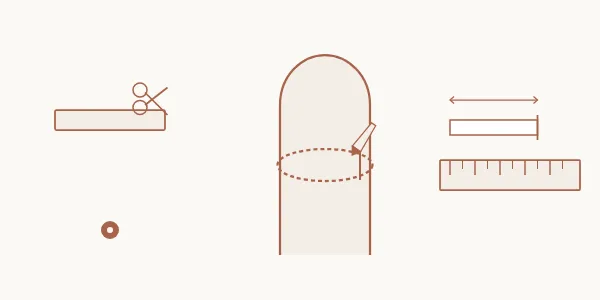
No tape measure? Wrap a strip of paper around your palm, mark the overlap and lay it flat against a ruler. Paper is better than string, which stretches and will give you a size too small.
Take the smaller size in leather and the larger in anything knitted or lined. Leather moulds to the hand within a few wears; wool, fleece and lined gloves do not, and a lining takes up more room inside the glove than the measurement suggests.
Short answer:
Palm circumference gives you the size. Hand length tells you whether the fingers will fit. A narrow palm with long fingers is common, and it is why a glove can be comfortable across the hand while bunching or pulling at the fingertips.
Every glove size chart asks for palm circumference and stops there, which works for roughly two thirds of people and quietly fails the rest. The palm measurement sets the width of the glove. It says nothing about how long the fingers are, and hands vary in that proportion far more than they vary in width. Two people with identical seven inch palms can have half an inch of difference in hand length, which is an entire glove size worth of finger.
The symptoms are easy to recognise once you know what you are looking at. If gloves fit across the palm but leave empty space at the fingertips, your fingers are short for your palm and you need a size down in length, not in width. If gloves feel correct across the hand but pull at the tips and stop you curling your fingers, the opposite is true. Neither problem is solved by changing size, because changing size changes both dimensions at once.
The practical fix depends on what you are buying. Leather dress gloves from a proper glovemaker are often available in more than one length for the same size, described as short, regular or long fingers — and this is one of the few remaining reasons to buy gloves from a specialist rather than a general retailer. For everything else, size to the palm and accept the finger length, or choose a style where it matters less: knit, fleece and lined gloves forgive a great deal that a fitted leather glove does not.
Long fingers for the palm · gloves pull at the tips
Short fingers for the palm · gloves bunch at the tips
Same glove size. Two different fits.
Short answer:
A new leather glove should be snug enough that you notice it. Leather stretches across the width within a few wears and moulds to your hand permanently. A leather glove that is comfortable in the shop will be loose within a month.
This is the single most useful thing to know before buying leather gloves, and almost nowhere says it. Leather is a skin, and it behaves like one: it gives across the width as it warms, takes the shape of the hand inside it, and keeps that shape. A women's leather glove size chart tells you the size to order (just as any women's glove size chart does); it does not tell you that the correct size will feel uncomfortably close for the first few wearings. People who have not been told this consistently buy half a size up and end up with gloves that slide.
What leather does not do is stretch lengthways. The fingers will not get longer, which is why hand length matters more in leather than in anything else, and why a specialist glovemaker will offer the same size in more than one finger length. If a leather glove is tight across the palm, wear it. If it is short at the fingertips, exchange it.
Lined leather is the exception worth remembering. A cashmere or silk lining takes up real space inside the glove and does not compress much, so lined leather is usually bought at the same size as unlined but will feel roomier for longer. Suede and deerskin stretch more than lambskin or peccary, so where a maker states the leather, that tells you how much give to expect.
Short answer:
Leather dress gloves need to be exact and bought snug. Knit and lined gloves are forgiving and should be bought at your measured size or slightly up. Touchscreen gloves need to be close at the fingertips to work at all.
The table below is what our calculator uses when you select a glove type, and it is the reason the guidance line under your result changes depending on what you are buying.
One-size gloves are usually knitted and sit around a size 7 with stretch either way. If you measure above 7½ or below 6½, check before buying.
Short answer:
Heritage glovemakers run true to the numbered sizes. Fashion and high street brands mostly use S/M/L and vary by up to a full size between them.
Numbered glove sizes are reliable, because the number is the measurement. Letter sizes are not, because each brand decides what a medium means. The table below records which system each maker uses and which direction it drifts, and is reviewed quarterly.
Reviewed quarterly. Last updated September 2026. Where a maker publishes its own chart, use it — this table describes the direction of drift, not a replacement for the brand's own measurements.
Everything you need to know about palm fit, stretch and break-in.
How sizing varies across dress, driving, winter, knit and touchscreen gloves.
Why palm circumference sets width while hand length decides finger fit.
Glove sizing is the most honest size system on this site, and the one most often reduced to a single number it cannot support on its own. Here is what sits behind ours.
The numbered glove size is the palm circumference in inches, measured at the knuckles with the thumb excluded. That convention is French in origin and has survived unchanged across the United States, Britain and Europe, which is why there is no country conversion on this page — a size 7 is a size 7 everywhere. Centimetre equivalents are the same measurement converted at 2.54 centimetres to the inch. The letter column maps numbered sizes to the S/M/L scale most fashion brands now use, given as the common mapping rather than as an authority, because each brand sets its own.
Because palm circumference sets the width of a glove and nothing else. Finger length varies independently of palm width, and a glove that is correct across the hand can still be wrong at the fingertips. Asking for both lets the calculator tell you when your two measurements disagree and what to do about it, which is the situation a single-measurement chart silently gets wrong. The second measurement is optional because most people are close to proportional and do not need it.
Three situations. Brands using letter sizes only, where a medium may cover a different range than the one here and the maker's chart is the only authority. Lined and insulated gloves, where the lining takes up space the measurement cannot account for. And anything knitted, where the size is a stretch range rather than a point. In all three the measurement is still worth having — it just needs to be read against the specific glove.
For the trade's own account of glove sizing, Dents have been making gloves in England since 1777 and publish a sizing guide that explains the numbered convention and finger lengths from the inside. For a plain measuring reference with no commercial interest attached, Alfred University publishes a guide to determining glove size that has become one of the most widely cited online.
Women's Glove Size Chart: Numbers, Letters, Inches and Centimetres
Measure Your Hand for Glove Size
01 Palm circumference
02 Hand length
03 Use your dominant hand
If you are between sizes
Why One Measurement Is Not Enough
Why Leather Gloves Should Feel Too Tight at First
How Much the Size Matters, by Glove Type
Which Glove Brands Run Small, Large or True
How a Glove Should Fit
Choose the Right Size for Your Glove
Two Measurements Matter
How This Calculator Works
What this glove size calculator is built on
Why we ask for hand length as well
Where this calculator is least reliable
Hat Size Calculator: Inches, Centimetres and Fitted Sizes
This hat size chart converts between every system in ordinary use. Read the circumference columns first, because those are the only figures you can measure on yourself — everything else is derived from them. The US fitted size is the circumference in inches divided by pi, which is why it lands on eighths rather than on whole numbers. The European size is simply the circumference in centimetres, making it the most readable system of the four. UK sizes run one eighth below US sizes for the same head, a difference small enough to be easy to miss and large enough to matter in a structured hat.
Between two rows? Round up. A hat that is slightly large can be sized down with a foam sizing tape; one that is too small cannot be made bigger.
Short answer:
The fitted hat size is your head circumference in inches divided by pi. A 23⅞ inch head divided by 3.14 is 7.6, which is written as 7⅝. The number is not a measurement of your head — it is the diameter of the circle your head would be if it were perfectly round.
There is a thread on the hats forum titled, roughly, that American inch hat sizing makes no sense. It is a fair complaint, and the explanation is genuinely strange. Hatters have worked from oval wooden blocks for centuries, and those blocks were described by their diameter rather than by the distance around them. So when sizing was formalised, the number that stuck was the diameter — circumference divided by pi — rather than the circumference itself. That is why fitted hats come in eighths, and why a hat size in cm and a hat size in inches look like numbers from two different planets. A 61 cm hat is a 7⅝, and nothing about those two figures suggests they describe the same head.
Once you know the rule, the whole system becomes arithmetic you can do in your head. Divide inches by roughly 3.14 and round to the nearest eighth. Going the other way, multiply the fitted size by 3.14 for inches, or by about 8 for centimetres. A 7½ is 23½ inches or 60 centimetres. A 7⅛ is 22⅜ inches or 57 centimetres. Each eighth of a size is about half an inch of circumference, or a little over a centimetre — which is why a single eighth is the difference between a hat that sits and one that slides.
European sizing sidesteps the whole problem by using the circumference in centimetres as the size, exactly as European ring sizes do. An EU 58 hat fits a 58 centimetre head. If you are buying from a European maker and have your measurement in centimetres, there is nothing to convert at all. The conversion only becomes necessary going into the American or British systems, and the table below does that for every eighth in common production.
One eighth of a size is about 1.3 centimetres of circumference. That is the entire difference between two neighbouring sizes.
Tape sits ~1 cm above eyebrows and directly over ears.
Short answer:
Run a tape measure around your head just above the ears and across the middle of your forehead, where a hat would naturally sit. Keep it snug but not tight. That figure is your head circumference, and every hat size on this page comes from it.
A hat sits above the ears and across the middle of the forehead, roughly a centimetre above the eyebrows. That is the line to measure, not the widest point of your skull and not around the hairline. Measure too high and every hat you buy will be loose; too low and nothing will go on.
Hold the tape level all the way round and pull it until it sits against your head without compressing. If you can slide a finger underneath without effort, it is too loose. Take the reading in centimetres if you can — European sizing uses that figure directly, so it saves a conversion.
If you wear your hair up, down, braided or in a bun under hats, measure with your hair that way. The difference is frequently a full size. Measure two or three times and use the largest reading, since the tape tends to sit slightly high on the first attempt.
No tape measure? Use a strip of paper or a shoelace, mark the overlap, then lay it flat against a ruler. It is the same method as measuring a ring, and it is just as accurate.
Round up and use a foam sizing tape inside the sweatband. They cost very little, come in several thicknesses, and are how hat shops have fitted between-size customers for a century. There is no equivalent trick for a hat that is too small.
Short answer:
Heads come in three broad oval shapes — long oval, regular oval and round oval. A hat in the correct size will still fit badly if it is blocked for a different shape. If a hat feels tight front to back but loose at the sides, you have a long oval head and the hat is a round oval.
Head circumference tells you how much hat you need. It does not tell you what shape that hat should be, and heads vary more in shape than most people realise. A long oval head is noticeably deeper front to back than it is wide. A round oval is closer to circular. A regular oval sits between them, which is what most mass-market hats are blocked for, and which is why most mass-market hats fit most people acceptably and nobody perfectly.
The symptoms are specific and easy to recognise once you know them. A hat that pinches at the forehead and the back of the head while gaping above the ears is too round for you. A hat that grips at the sides and leaves a gap at the front is too long. In both cases the size is correct — the shape is not, and no amount of sizing up will fix it, because sizing up simply makes the wrong shape bigger.
Structured hats show this most: fitted caps, fedoras, boaters and cowboy hats are all blocked to a shape and hold it. Soft hats forgive almost everything, which is why a beret, a beanie or a bucket hat will sit on any head at the right size. If you have struggled with structured hats and assumed you were between sizes, shape is the more likely explanation, and a good hatter can steam a hat to your shape in a few minutes.
Long oval · deeper front to back · pinches at the forehead in a round hat
Regular oval · what most hats are blocked for
Round oval · wider side to side · gaps at the front in a long hat
Same circumference. Three different hats.
Short answer:
Cowboy hats use the same fitted size numbers as any other hat — a 58 cm head is a 7¼. What differs is the fit: western hats are meant to sit firmly and are shaped to the wearer, so they are bought snug rather than comfortable and steamed to fit afterwards.
A cowboy hat size chart looks identical to any other hat chart, because it is. The numbers are the same fitted sizes derived the same way. The difference is in what a correct fit feels like. A western hat is expected to stay on through wind, movement and a vehicle door, so it is fitted more firmly than a fedora or a cap — snug enough to leave a faint line on the forehead after an hour, without giving you a headache.
The second difference is that felt western hats are shaped, not just sized. A hatter will steam the crown and brim to your head and to the shape you want, and a good quality felt hat can be reshaped repeatedly over its life. This is why western retailers push so hard on buying in person: the size gets you to the right hat, and the steaming makes it yours. It is also why an oval-shaped head is far less of a problem in western hats than in fitted caps — the hat is adjusted to you rather than the reverse.
For buying online, the practical rules are straightforward. Order your measured size rather than sizing up. Expect a new felt hat to feel firmer than you think is right, because it will relax slightly with wear. And check whether the maker uses standard fitted sizes or its own S/M/L scale, since western brands are split between the two and the S/M/L versions vary noticeably between houses.
Short answer:
Structured hats need an exact size. Soft hats do not. A fitted cap or a fedora has to be right to the eighth; a beret, beanie or bucket hat will sit happily a size either way.
Not every hat needs the same precision, and knowing which ones do saves a great deal of returning. The table below is what our calculator uses when you select a hat type, and it is the reason the guidance line under your result changes depending on what you are buying.
Snapbacks and adjustable caps are not in this table because they have no size — they run roughly 55 to 61 centimetres and adjust within that range.
Short answer:
Head size is not gendered — a 58 cm head is a 7¼ whoever it belongs to. What differs is the labelling. Women's hats are frequently sold as S/M/L or one-size-fits-most with an internal band, while men's hats are sold in numbered fitted sizes.
There is no such thing as a women's head measurement, and a women's hat size chart is not a separate scale. It is the same circumference converted the same way. The genuine difference is commercial: women's millinery and fashion hats have long been sold in letter sizes or as one-size-fits-most, while men's hats kept the numbered fitted convention from the hatters. Average measurements do differ a little between the two markets, which is why a women's medium and a men's medium are not always the same centimetre range, but the arithmetic underneath is identical.
One-size-fits-most is the part worth understanding before you buy. It usually means the hat is blocked at around 57 to 58 centimetres with an elasticated or adjustable inner band that gives an extra centimetre or two. If you measure above 59, one-size will be tight, and if you measure below 55 it will sit low no matter what the band does. Either way, the measurement tells you before the hat arrives, which is the entire point of taking it.
Hair changes the answer here more than anywhere else. A hat bought to fit over loose hair will be loose over a sleek style, and a hat fitted to a bun will not go on otherwise. If you wear your hair several different ways, measure both extremes and buy for the larger, then use a sizing tape for the smaller.
Letter ranges vary between brands by a centimetre or so. Where a maker publishes its own chart, that chart wins.
Short answer:
Fitted cap makers run close to standard. Fashion and sun-hat brands vary widely because many use their own letter scales rather than fitted sizes.
Every number on this page assumes a maker cuts to the standard scale, and in hats that assumption holds better than in clothing — the circumference is a physical fact. Where brands diverge is in the shape they block to and in whether they use fitted sizes at all. The table below records both, and is reviewed quarterly.
Reviewed quarterly. Last updated September 2026. Where a maker publishes its own chart, use it — this table describes the direction of drift, not a replacement for the brand's own measurements.
Step-by-step instructions with photos and a printable guide.
How sizing varies for caps, berets, bucket hats, fedoras and more.
How to adjust a hat that is slightly large and what to do if it is tight.
Hat sizing has a genuine formula behind it, which makes it unusual among the size systems on this site. Here is the formula and where it stops being enough.
The fitted size is the head circumference in inches divided by pi, rounded to the nearest eighth — the same derivation hatters have used since blocks were described by diameter. The European size is the circumference in centimetres, used directly with no conversion. UK sizes sit one eighth below US sizes for the same head, a convention that has held since the two trades diverged. Letter sizes are ranges rather than points, and because they vary between makers we give the centimetre range each letter covers rather than a single equivalent. Every row in the chart is calculated from the formula and cross-checked against the published charts of the ten makers in the table above.
Because it is the only one that determines whether a hat goes on. Head length, width and crown height all affect how a hat looks and how it sits, but none of them changes the size you order. Asking for them would imply a precision the size system does not have. The shape question matters enormously and is covered in its own section, but it is a question of which hat to choose, not which number to order.
Three situations. Brands using their own letter scales, where a medium may cover a different range than the one here and the maker's chart is the only authority. Heads that are markedly long or round oval, where the correct size can still fit badly and the fix is shape rather than number. And anything knitted or adjustable, where the size is a range and the calculation is close to meaningless. In all three, the measurement is still worth having — it just needs to be read against the specific hat rather than against a general chart.
For a plain conversion reference with no commercial interest attached, Baruch College publishes a hat conversion chart for its commencement regalia that has become one of the most widely used tables online. For the trade's own account of sizing, Lock and Co Hatters, who have been fitting hats in London since 1676, publish a sizing guide that explains the British convention from the inside.
Hat Size Chart: US, UK, EU and Letter Sizes
Why Hat Sizes Are Fractions Like 7⅝
Fitted size to centimetres
6¾
54 cm
6⅞
55 cm
7
56 cm
7⅛
57 cm
7¼
58 cm
7⅜
59 cm
7½
60 cm
7⅝
61 cm
7¾
62 cm
7⅞
63 cm
8
64 cm
Most searched
How to Measure Hat Size at Home
01 Find the line the hat will sit on
02 Measure snug, not tight
03 Measure the way you will wear it
If you are between sizes
Your Head Shape Matters as Much as Your Head Size
Cowboy Hat Size Chart and How Western Sizing Differs
How Much the Size Matters, by Hat Type
Women's Hat Size Chart and Why It Looks Different
Which Hat Brands Run Small, Large or True
Measure Your Head Size
Find the Right Size for Your Hat
Get a Better Fit
How This Calculator Works
What this hat size calculator is built on
Why circumference is the only measurement we ask for
Where this calculator is least reliable
Dress Size Calculator: Everyday, Bridal and Prom
This dress size chart gives the body measurements each size is cut for, not the finished garment — every dress is made with ease on top of these figures, and how much ease depends entirely on the cut. Read it as a starting point rather than a guarantee. The US column runs the familiar numeric scale, the UK column sits two numbers above it, the European column sits thirty-two above, and Italian sizing runs four above the European number. Both inches and centimetres are given on every row, so a dress size in cm is readable without converting anything first.
Bridal and prom dresses usually run smaller than everyday sizing, often by one or two sizes. Use this guide to find the equivalent size across the three systems for the same measurements.
Measuring in centimetres? Every row gives both — an 89 cm bust is a 35, which is a US 6.
Short answer:
Bridal sizing typically runs one to two sizes smaller than everyday sizing. Someone who wears a US 6 on the high street will usually order a bridal 8 or 10. Prom and formal gowns sit close to bridal. The number is a manufacturing convention, not a measurement of you.
If you have ever come out of a bridal appointment slightly winded by the number on the tag, this is why. Bridal houses never moved to the revised sizing that the rest of the clothing industry adopted over the past several decades. Where high street sizes have been quietly relabelled downward — the thing usually called vanity sizing — bridal held onto an older, smaller scale. The result is that two dresses cut for identical bodies carry different numbers depending on which side of that divide they were made. Nothing about you changed between the two shops.
Prom, pageant and formal gowns sit on the same older scale, or close to it, which is why a prom dress size chart looks more like a bridal one than like the chart from the shop where you buy jeans. Formalwear manufacturers and bridal manufacturers are frequently the same houses, and the patterns share a lineage.
There is a practical reason beyond history. Gowns are ordered months before they are worn and are always altered to fit, so the convention is to order to the largest of your three measurements and take the rest in. Bringing a seam in is routine; letting one out often is not possible at all, because there may be no fabric in the seam allowance to work with. That is also why a wedding dress size calculator should never give you a single confident number — it should give you the size your largest measurement falls into, and tell you which alteration is coming.
One more thing worth knowing before an appointment. Every bridal house publishes its own chart and they genuinely differ, sometimes by a full size between designers in the same shop. The chart below is a representative bridal scale, useful for knowing roughly where you will land and for not being caught off guard. When it comes to ordering, the designer's own chart is the only one that counts, and a good bridal consultant will measure you against it in front of you.
Representative scales only. Bridal and formal houses each publish their own chart and they differ meaningfully — always order against the designer's chart, not a general one. Reviewed September 2026.
Most bridal gowns are made to order and take six to eight months to arrive, plus six to eight weeks for alterations. Prom gowns are faster but sell out by size well before the season. Neither timeline leaves room for a size exchange, which is the real reason sizing up and altering down is standard practice.
Short answer:
Subtract 4 from a UK dress size to get the US size. A UK 10 is a US 6 and a UK 12 is a US 8. For Europe, subtract 32 — an EU 38 is a US 6. Italian sizes run four above European ones, so an Italian 42 is also a US 6.
Converting a uk dress size to us sizing is the most common cross-border question on this page, and it is a straight subtraction of four across the whole range. It holds whether you are a UK 6 or a UK 24. The confusion comes from the fact that the numbers look plausible in either system — a UK 12 and a US 12 are both ordinary sizes, so nothing about the label signals that you are reading the wrong scale.
European conversion is the same idea with a different constant. An eu dress size to us conversion subtracts thirty-two, and going the other way — us dress size to eu — adds it back. Germany, Spain, the Netherlands and Scandinavia all share this scale, and because it derives from body measurements in centimetres rather than from a retailer's own numbering, it tends to be the most consistent of the three. An italian dress size to us conversion needs one extra step: Italy runs four numbers above the European scale, so subtract four first and then thirty-two.
The arithmetic is reliable. The cut is not. European dresses are generally drafted for a longer torso and a narrower shoulder than American ones at the same nominal size, and Italian ready-to-wear is narrower again through the shoulder and upper arm. If you are ordering from a European label for the first time and your measurements sit between two sizes, the larger one is usually the safer choice for anything fitted.
Short answer:
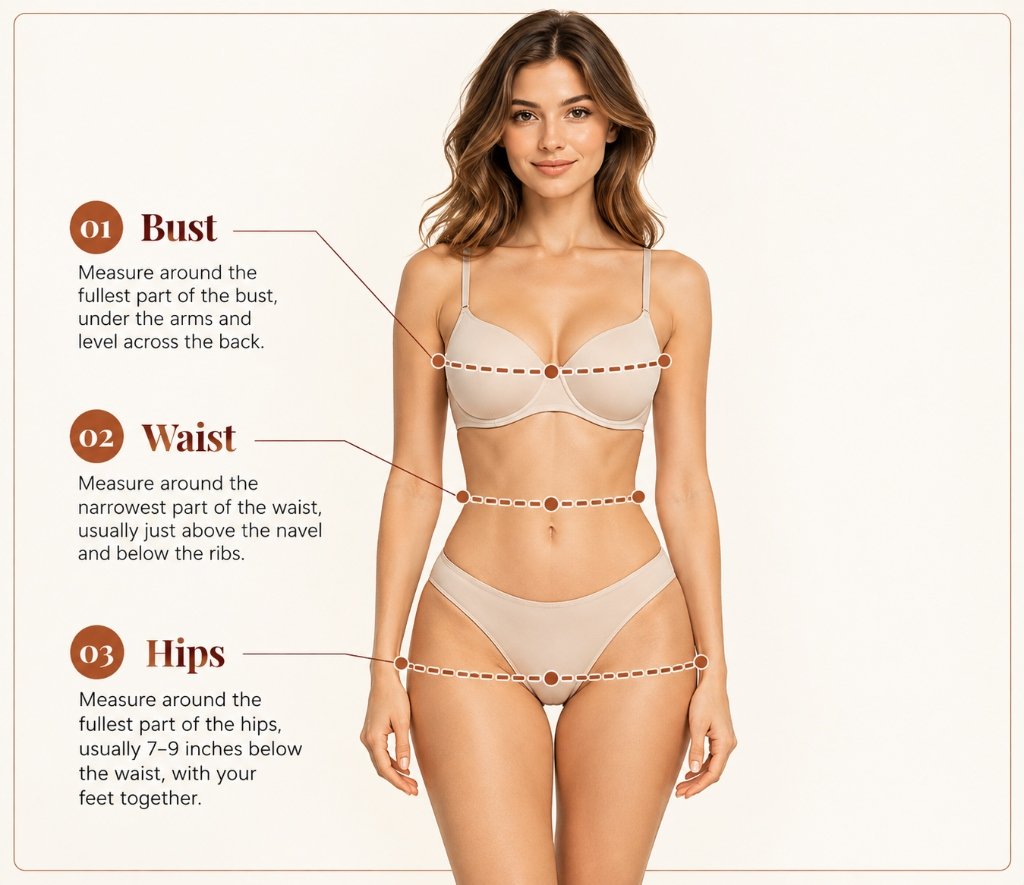
Measure the fullest part of the bust, the narrowest part of the waist and the fullest part of the hips, over close-fitting underwear with the tape level. Those three numbers are your dress size by measurements — the label on your last dress is not.
Run the tape around the fullest part, under the arms and level across the back. Wear the bra you intend to wear under the dress, since a different bra can change this figure by an inch or more. Stand relaxed and do not pull the tape tight.
Find the narrowest point, usually just above the navel and below the ribs. Bending to one side reveals the natural crease if you are unsure. Keep a finger's width under the tape rather than measuring flush.
Measure the fullest point, usually seven to nine inches below the waist, feet together. Check in a mirror that the tape is level behind you, which is where it most often slips.
Write all three down. Every size tool on this site runs from them, and none of them need to know your weight.
Short answer:
Hips decide bodycon and slip dresses. The bust decides fit-and-flare and wrap dresses. The largest measurement decides shifts, and ball gowns need both bust and waist. No dress is decided by all three equally.
Most dress size calculators take three measurements, find the size that fits the largest of them, and hand you a number. That is the safe answer, and for a structured dress it is the right one. But it will send you a size too large for a wrap dress and a size too small for a strapless gown, because different cuts load the fit onto different parts of the body. The table below is what our calculator uses when you select a dress type, and it is worth reading even if you never use the tool.
Where two measurements are given, size to whichever falls higher on the chart.
Short answer:
Fast fashion generally runs small, mid-market runs true, and several premium labels run generous. Formal and bridal labels run smaller than all of them.
Every number on this page assumes a brand cuts to the standard, and plenty do not. The table below records the direction of the drift for labels commonly ordered across borders, alongside the scale each uses. It is compiled from published brand charts and returns patterns, and reviewed quarterly. Once you have narrowed down a size, this table is more useful than any conversion chart.
Reviewed quarterly. Last updated September 2026. Brands change fit blocks without announcing it — when a result falls between two sizes, the dress type decides.
Step-by-step instructions for bust, waist and hips with tape placement photos.
How necklines, silhouettes and stretch determine which number decides your size.
When to size up, when to size down, and what a seamstress can realistically alter.
Dress sizing has less standardisation behind it than almost anything else you can buy, and most of the charts online belong either to a retailer describing its own cut or to a generic calculator with no fashion context at all. Here is what sits behind ours.
The measurement ranges come from published body-measurement conventions rather than from any single retailer's chart, and the numeric US sizes are mapped to those measurements. The UK column sits four numbers above the US one, the European column thirty-two above, and the Italian column four above the European. The bridal and formal scales are separate tables, built from the charts several bridal and formalwear houses publish, presented as a representative range rather than as a single authority — because in bridal there genuinely is no single authority. Every row is cross-checked against the ten brands in the table above, and where a brand departs meaningfully from the standard we record the direction rather than folding it into the baseline.
Because those two figures cannot produce a reliable dress size. Two people of identical height and weight routinely wear sizes three apart, since clothing is cut to the circumference of the bust, waist and hips rather than to mass or stature. A calculator that offers a size from height and weight alone is guessing, and it tends to guess in a direction that makes people feel worse rather than dress better. Two minutes with a tape measure beats it every time, and the tape does not care what the scale says.
Three situations. Bodies whose bust, waist and hip measurements fall in three different size bands, which is extremely common and is why we report a range and name the dress type rather than pretending to a single answer. Heavily structured garments — corseted bodices, boned gowns, tailored jackets — where the shoulder and armhole matter more than any circumference. And high-stretch fabric, where the correct size is often smaller than any measurement suggests. In all three, trying two sizes or asking a seamstress will beat a calculator, including this one.
For the history of how American numeric sizing drifted so far from measurement, Wikipedia's entry on US standard clothing size is the clearest neutral account available. For bridal specifically, The Knot's explanation of wedding dress sizes is a useful second opinion from outside the shops that sell the gowns.
Women's Dress Size Chart: US, UK, EU, Italian and French
US
UK
EU
ITALY
FRANCE
LETTER
BUST (in/cm)
WAIST (in/cm)
HIPS (in/cm)
0
4
32
36
32
XXS
31 / 79
24 / 61
34 / 86
2
6
34
38
34
XS
32 / 81
25 / 64
35 / 89
4
8
36
40
36
S
34 / 86
27 / 69
37 / 94
6
10
38
42
38
S
35 / 89
28 / 71
38 / 97
8
12
40
44
40
M
37 / 94
30 / 76
40 / 102
10
14
42
46
42
M
39 / 99
32 / 81
42 / 107
12
16
44
48
44
L
41 / 104
34 / 86
44 / 112
14
18
46
50
46
L
43 / 109
36 / 91
46 / 117
16
20
48
52
48
XL
45 / 114
38 / 97
48 / 122
18
22
50
54
50
XL
47 / 119
40 / 102
50 / 127
20
24
52
56
52
XXL
49 / 124
42 / 107
52 / 132
22
26
54
58
54
XXL
51 / 130
44 / 112
54 / 137
24
28
56
60
56
3XL
53 / 135
46 / 117
56 / 142
Bridal and Prom Size Guide
MEASUREMENT (bust/waist/hips)
EVERYDAY (US)
BRIDAL (US)
PROM (US)
EU
UK
32 / 25 / 35
2
0
0
34
6
34 / 27 / 37
4
2
2
36
8
35 / 28 / 38
6
4
4
38
10
37 / 30 / 40
8
6
6
40
12
39 / 32 / 42
10
8
8
42
14
41 / 34 / 44
12
10
10
44
16
43 / 36 / 46
14
12
12
46
18
Why Bridal and Prom Sizes Run Smaller
Bridal Size Chart (Representative)
BRIDAL SIZE
BUST (in)
WAIST (in)
HIPS (in)
USUAL EVERYDAY SIZE
2
32½
25
35½
US 0
4
33½
26
36½
US 0–2
6
34½
27
37½
US 2–4
8
35½
28
38½
US 4–6
10
36½
29
39½
US 6–8
12
38
30½
41
US 8–10
14
39½
32
42½
US 10–12
16
41
33½
44
US 12–14
18
43
35½
46
US 14–16
20
45
37½
48
US 16–18
Prom and Formal Sizing
PROM SIZE
BUST (in)
WAIST (in)
HIPS (in)
USUAL EVERYDAY SIZE
0
32
24½
35
US 0
2
33
25½
36
US 0–2
4
34
26½
37
US 2–4
6
35
27½
38
US 4
8
36
29
39½
US 6
10
37½
30½
41
US 8
12
39
32
42½
US 10
14
40½
33½
44
US 12
16
42
35
45½
US 14
Order early
UK Dress Size to US, and Other Conversions
US
UK
EU
ITALY
FRANCE
0
4
32
36
32
2
6
34
38
34
4
8
36
40
36
6
10
38
42
38
8
12
40
44
40
10
14
42
46
42
12
16
44
48
44
14
18
46
50
46
16
20
48
52
48
18
22
50
54
50
What Dress Size Am I? How to Measure
01 Bust
02 Waist
03 Hips
Which of Your Three Measurements Actually Decides the Size
DRESS TYPE
SIZE BY
IF YOU ARE BETWEEN SIZES
Bodycon or fitted
Hips
Take the larger; the waist can be taken in
Fit-and-flare
Bust
Take the larger; the skirt has room already
Shift or A-line
The largest of the three
Take the larger
Wrap
Bust, loosely
Either works; the tie adjusts the waist
Ball gown
Bust and waist
Take the larger; skirt volume hides the hip
Strapless or corseted
Bust and underbust
Take the smaller for support
Slip or bias-cut
Hips
Take the larger; bias fabric shows every seam
Which Dress Brands Run Small, Large or True
Get Accurate Measurements
Which Measurement Matters?
Between Sizes?
How This Calculator Works
What this dress size calculator is built on
Why we do not ask for your height or weight
Where this calculator is least reliable
Jeans Size Converter: US, EU, UK, Waist and W×L
Women’s Jeans Size Chart: US, Waist, EU, UK and W×L
This women’s jeans size chart puts all four numbering systems in one place, which almost no chart does. Read the waist column as the body measurement the size is cut for, not as the number printed on the tab — those two have not matched for decades. The W column is the same figure expressed the way denim brands write it, so a W28 and a size 28 are the same garment described twice. The EU column runs on the standard European scale, and the UK column sits two numbers above the US one, as it does for every other garment.
Inseam Lengths (the L in W×L)

Why the Number on the Tab Is Not Your Waist
Short answer: A pair of jeans labelled 28 is usually cut for a waist of 29 to 30 inches. Vanity sizing has added one to two inches across most of the market, and more at the premium end. Measure yourself, then read the waist column rather than trusting the tab.
Here is an experiment worth doing. Take a tape measure to a pair of jeans you already own, measure straight across the waistband from side seam to side seam, and double it. Then compare that figure to the number printed on the tab. On most modern denim you will find a gap of one to two inches, and on premium labels it is often more. The tab is not lying, exactly — it is describing a size, not a measurement. But if you have ever measured a 28 inch waist, bought size 28 and found it loose, this is the entire explanation.
Vanity sizing has crept through the whole market over several decades, and denim has drifted further than almost any other garment because the number feels personal in a way that a letter does not. The practical consequence is that a waist size to jeans size conversion done by matching numbers will put most people one size too large. Our converter handles this by asking for your body measurement and returning the tab number that fits it, rather than assuming the two are the same thing.
Fabric adds a second layer. Rigid hundred per cent cotton denim will not give at all, so your exact waist measurement is the size to take. A blend with one or two per cent elastane will relax roughly half an inch after an hour of wear, which is why so many people size down in stretch denim and are right to. Anything above three per cent elastane behaves more like a legging than like jeans, and should be bought snug.
Size 28
29 to 30 inch waist
Measure your body. Let the chart find the tab.
Jeans Size Conversion Between the US, Europe and the UK
Short answer: Add 32 to the US size for the European number and add 2 for the UK number. A US 6 is an EU 38 and a UK 10. A US 8 is an EU 40 and a UK 12. European denim also runs longer in the leg than American denim at the same size.
Jeans size conversion between the three main systems is arithmetic, at least on paper. The European number is the US number plus thirty-two, and the British number is the US number plus two. That holds across the whole range, so a us jeans size to eu conversion is the same addition whether you are a 2 or a 20, and going the other way is the same subtraction.
What the arithmetic does not capture is the cut. European denim is generally drafted for a longer leg and a slightly higher rise than the American equivalent, so an eu to us jeans size conversion that is numerically perfect can still arrive too long. Scandinavian labels are the most pronounced example. Going the other way, American denim frequently arrives short on European customers, which is why the inseam column matters more on this page than the waist one.
British sizing sits closest to American, and a uk to us jeans size conversion rarely surprises anyone. The one thing worth knowing is that British denim tends to be labelled in whole sizes only, where American brands often split the difference with odd waist numbers, so a conversion from UK will sometimes land between two US options. Take the smaller one in stretch denim and the larger one in rigid.
Men’s to Women’s Jeans Size Conversion
Short answer: Men’s jeans are labelled by waist in inches, women’s by a numeric size. Subtract 21 from the men’s waist to get the women’s size — a men’s 30 is roughly a women’s 9, so a women’s 8 or 10. The cut differs more than the number does.
A mens to womens jeans size conversion comes up more often than the charts suggest. Thrifted and vintage denim is mostly sold in men’s sizing, the boyfriend and dad fits that have been in rotation for years are cut on men’s blocks, and plenty of people simply find men’s denim better made at the same price. The arithmetic is straightforward: women’s numeric sizes run roughly twenty-one below the men’s waist measurement in inches.
The number is the easy part. Men’s jeans are drafted with a straighter hip-to-waist ratio, a lower rise at the back and a wider thigh, so a numerically correct conversion can fit at the waist and gape at the back or sit wide through the seat. If you are between options, take the smaller waist and accept the looser leg — a waistband can be taken in inexpensively, where a seat cannot be let out. Belt loops on men’s denim are also spaced for a wider belt, which is worth knowing before you assume something does not fit.
Going the other direction, a womens to mens jeans size conversion adds twenty-one back. A women’s 10 is roughly a men’s 31, which most brands round to a 30 or a 32. Length is the thing to check here rather than waist: men’s denim is cut for a longer inseam at every waist size, so the L number is doing more work than the W number.
Ranges appear where men's and women's scales do not line up evenly. Where two options are given, the smaller usually fits better in stretch denim.
Short answer:
Measure your natural waist where the jeans will actually sit, your hips at the fullest point, and your inseam from crotch to ankle bone. The waist gives the W, the inseam gives the L.
Find where the waistband will actually sit, which for most modern jeans is a couple of inches below the natural waist rather than on it. Keep the tape level and snug without compressing, and stand normally rather than holding your breath.
Measure the fullest point, usually seven to nine inches below the waist. If your hip measurement puts you two sizes above your waist measurement, buy for the hips and take the waistband in — that is a twenty minute job for any tailor and the most common jeans alteration there is.
Measure from the crotch seam down the inside of the leg to your ankle bone, in the shoes you intend to wear. Round down for a cropped look and up for a full-length one. This figure is the L in W×L, and it is the reason two people who wear the same size can have completely different experiences of the same jeans.
Write all three down. Every size tool on this site runs from them.
Waist Size to Jeans Size: How to Measure
01 Waist
02 Hips
03 Inseam
Short answer:
Premium denim generally runs small and rigid, mid-market denim runs true to the tab, and high street denim runs generous. Stretch content matters more than the label.
Every conversion on this page assumes a brand cuts to the standard. Denim brands vary more than almost any other category, because the number on the tab has become a positioning decision as much as a measurement. The table below records the direction of that drift for labels commonly bought across borders, alongside the stretch content that determines whether you should size down. It is compiled from published brand charts and returns patterns, and reviewed quarterly.
Reviewed quarterly. Last updated September 2026. Brands change fit blocks without announcing it — when a result falls between two sizes, the stretch content decides.
Which Denim Brands Run Small, Large or True
Measure Your Waist and Inseam
Step-by-step instructions to get the right numbers for jeans.
How Jeans Should Fit
A simple guide to rise, leg shape and the right length for your height.
Best Jeans for Your Body Shape
Find styles suited to your proportions, height and build.
How This Converter Works
Almost every jeans size chart online belongs to a company selling denim, which means it describes that company’s cut and nothing else. This one is not selling anything, so here is what sits behind the numbers.
What this jeans size converter is built on
The waist and hip figures come from published body-measurement conventions rather than from any single brand’s chart, and the numeric US sizes are mapped to those measurements rather than to the tab numbers brands print. The European column follows the standard European scale, where the number is the US size plus thirty-two. The W figure is the same waist measurement expressed the way denim has always written it, and the L figure is a straight inseam measurement in inches. Each row is cross-checked against the published charts of the ten brands in the table above, and where a brand departs from the standard we record the direction rather than averaging it into the baseline.
Why the waist column and the tab number differ
Because they measure different things. The tab number is a size name; the waist column is the body it is cut for. Denim has drifted further from its own labels than any other garment category, typically by one to two inches and sometimes more at the premium end. A converter that treats the tab number as a measurement will send most people one size too large, so ours asks for your body measurement and returns the tab number that corresponds to it. If you would rather work from a size you already own, the second mode does that instead and says plainly that it inherits whatever drift that brand applies.
Where this converter is least reliable
Three situations. High-stretch denim above about three per cent elastane, which behaves closer to a legging and is usually bought a size down regardless of measurement. Bodies whose waist and hip measurements fall two or more sizes apart, where no single number is correct and the right answer is to buy for the hip and alter the waistband. And any fit with a dramatically different rise — a high-waisted style measures your natural waist while a low-rise measures several inches below it, so the same body produces two different numbers depending on where the garment sits. Our converter reports the range in all three cases rather than pretending to a precision it does not have.
For the history of how American numeric sizing became so detached from measurement, Wikipedia’s entry on US standard clothing size is the clearest neutral account available. For a single brand’s own measurements, Levi’s publishes one of the more transparent product size guides in the industry and is a useful reference point even if you never buy from them.
Inches to Ring Size Converter: Inches, Millimetres and Centimetres
Ring Size Chart: US, UK, EU, Circumference and Diameter
This ring size chart lists every system side by side, with both the inside circumference and the inside diameter for each size. Those two columns are the ones to read carefully. Circumference is the distance all the way around your finger, which is what you get from a paper strip. Diameter is the distance straight across the inside of a ring, which is what you get from a ruler laid across a ring you already own. They describe the same ring and differ by a factor of pi, so a diameter to ring size reading entered as a circumference will be badly wrong. The European column is worth noting too: an EU ring size is simply the circumference in millimetres, which makes it the most readable system of the three.
Measuring in centimetres? Divide by ten to read the millimetre column — 6.5 cm is 65 mm, which is a US 11.
Printable Ring Size Chart and On-Screen Sizer
Short answer: Print our paper sizer at 100% scale, check the calibration square with a ruler, then wrap the strip around your finger and read the size. If you have no printer, use the on-screen ruler and a bank card to calibrate the screen instead.
Search for a printable ring size chart and you will mostly download a jeweller’s PDF with no way to confirm it printed correctly. That is the flaw in every printed sizer: browsers and printers quietly rescale pages, and a strip printed at 94% will hand you a size that is a full size out. Ours carries a calibration square in the corner. Measure it with any ruler before you cut the strip, and if it is not exactly 50 millimetres across, set your printer to 100% or Actual Size and print again. The same problem applies on screen, which is why the on-screen version asks you to match a bank card — every card in the world is the same size, so it makes a reliable reference.
Printable Paper Sizer
Also available as a printable ring size chart with all systems.
On-Screen Ring Sizer
Works on phones and laptops. Nothing is uploaded.
UK Ring Size to US Conversion
Short answer: The UK uses letters, the US uses numbers, and they do not line up neatly. A UK L½ is a US 6, a UK N½ is a US 7, and a UK P½ is a US 8. Roughly, each US whole size is two letters plus a half in the UK alphabet.
Converting a uk ring size to us sizing is the one conversion on this page that cannot be done with arithmetic, because the two systems were built on different logic. American sizes are a numeric scale where each whole size adds about 2.55 millimetres of circumference. British sizes run through the alphabet in quarter-size letter steps, which is why the chart is full of half letters like J½ and R½. There is no formula — the chart is the answer.
This matters more than it sounds, because British, Irish and Australian jewellers all use the letter system, and Australia and New Zealand use the identical scale. If you are ordering from a British maker and the listing shows a letter, convert it here rather than guessing from the alphabet position. And if a size falls between two letters, British jewellers will generally cut the smaller of the two, where an American jeweller would round up.
EU Ring Size to US, and Other International Systems
Short answer: A European ring size is the inside circumference in millimetres. An EU 52 is a US 6, an EU 54 is a US 7, and an EU 57 is a US 8. Japan and China number their sizes on a separate scale of their own.
Converting an eu ring size to us sizing is the easiest job on this page, because the European number is not a code at all — it is the measurement. An EU 54 ring has an inside circumference of 54 millimetres. That makes any international ring size chart far more readable once you know it, and it means going the other way, us to eu ring size, is just a lookup of the circumference column above.
Germany, France, Italy, Spain and the Scandinavian countries all use this scale, sometimes written with a decimal such as 54.5. Japan runs a separate numeric sequence that looks similar to American sizing but is not — a Japanese 12 is a US 6 — and Chinese sizing follows the Japanese convention. Where a listing gives no system at all, the circumference in millimetres is the safest thing to ask the seller for.
Circumference or Diameter? Get This Wrong and You Are Three Sizes Out
Short answer: Circumference is around the finger. Diameter is straight across the inside of a ring. Circumference is roughly 3.14 times the diameter, so a 17 mm diameter and a 17 mm circumference are completely different rings — one is a US 7, the other does not exist.
Almost every wrong ring size starts here. A finger circumference to ring size conversion needs the distance all the way around, which you get from a paper strip or a tape. A diameter to ring size conversion needs the distance straight across the inside of a ring, which you get from a ruler laid across a ring you already own. Both are valid ways to find a size. Entering one where the other belongs is not.
You can usually catch the error by sanity-checking the number. Adult ring circumferences fall between roughly 44 and 70 millimetres, which is 1.7 to 2.75 inches. Adult inside diameters fall between roughly 14 and 22 millimetres. If your figure is around 17, it is a diameter. If it is around 54, it is a circumference. Our converter asks which one you took and refuses to guess, and it will tell you when a number lands somewhere no adult finger goes.
The other common error is measuring in the wrong place. The ring has to pass over your knuckle, so if your knuckle is noticeably wider than the base of your finger, measure both and choose something between the two — closer to the knuckle measurement for a snug band, closer to the base for a wide one. Measuring over the knuckle alone is why searches like three inches to ring size exist: that is a US 15 and a half, and almost nobody wears it.
Same ring. Two very different numbers.
How to Measure Your Ring Size at Home
Short answer: Wrap a strip of paper around the base of your finger, mark where it overlaps, and measure the length flat. That length is your circumference. Measure in the evening, at room temperature, and check the knuckle too.
01 Cut a strip
Use paper rather than string, which stretches. A strip about a centimetre wide and ten centimetres long is enough. Ribbon, dental floss and thread all give readings that are too small.
02 Wrap and mark
Wrap it around the base of the finger, snug but not tight — you should be able to turn it. Mark the exact overlap point with a pen, then slide it off without letting it shift.
03 Measure flat
Lay the strip against a ruler and read the length to the mark. That figure is your circumference. Check it passes over your knuckle by wrapping the strip there too, and if the knuckle reading is much larger, size between the two.
Repeat twice on different occasions. Fingers change more than people expect.
Six Things That Change Your Ring Size
Time of day
Fingers are smallest in the morning and largest in the evening. Measure at both if you can.
Temperature
Cold shrinks, heat swells. A measurement taken outside in winter is not your size.
Band width
Wide bands sit tighter. Add a quarter to a half size for anything over six millimetres.
The knuckle
The ring has to pass it. A prominent knuckle usually means sizing between base and knuckle.
Dominant hand
It is often a quarter to a half size larger than the other.
Over time
Ring size drifts with age, weight and pregnancy. A size from five years ago is a starting point, not a fact.
How This Inches to Ring Size Converter Works
Nearly every ring size chart online belongs to a company that would like to sell you a ring. That does not make them wrong, but it does mean none of them explain where the numbers come from or where they stop being reliable. Here is both.
What this inches to ring size converter is built on
Ring sizes are one of the few garment-adjacent measurements with a genuine international standard behind them. The European and ISO scale defines a size as the inside circumference of the ring in millimetres, which is why an EU 54 measures 54 millimetres around. The American scale is numeric, starting near 44 millimetres and adding roughly 2.55 millimetres per whole size. The British scale runs through the alphabet in quarter-size letter steps and has no formula at all, so it is handled as a lookup. Every row in our chart is derived from those definitions and cross-checked against the published sizing pages of several international jewellers. Where the sources disagree, and they do at the half sizes, we give the ISO-consistent value and say so. Specifically, the International Organization for Standardization defines ring size designation in ISO 8653:2016 based on internal circumference measured in whole millimetres. Our mathematical conversion engine adheres to this standard, ensuring that millimeter readings translate directly into recognized European and international retail sizes without rounding bias.
Why we ask which measurement you took
Because the same number means two different rings depending on the answer. A circumference of 17 millimetres is not a size anyone wears; a diameter of 17 millimetres is a US 7. Most converters accept a bare number and hope, which produces confidently wrong results. Ours asks first, sanity-checks the figure against the range adult fingers actually occupy, and says plainly when a reading looks like it was taken across the finger rather than around it, or over the knuckle rather than at the base. Dimensional confusion between circular perimeter and diameter is responsible for the majority of jewellery returns. By establishing explicit input classification before executing the conversion formula, our tool guarantees that users do not inadvertently scale their ring by a factor of pi.
Where this converter is least reliable
Three situations. Wide bands, which sit tighter than a narrow ring of the same nominal size and usually need a quarter to a half size added. Prominent knuckles, where no single measurement is correct and the right answer is a compromise you have to choose. And any ring that cannot be resized later — full eternity bands, tension settings, some carved and inlaid designs — where the cost of being half a size out is the cost of the ring. For those, a jeweller’s steel sizing set is worth the trip, and any reputable shop will size your finger for free. Furthermore, physiological variables such as humidity, dietary sodium, circadian fluid retention, and seasonal temperature fluctuations can alter digital circumference by up to half a millimetre over twenty-four hours.
For the measurement conventions themselves, Wikipedia keeps a well-sourced overview of ring size systems including the ISO definition. For a buyer’s perspective on choosing a size for someone else, Blue Nile’s guide to finding your ring size is among the more thorough retailer explanations and is worth reading before a surprise purchase. You can consult Blue Nile’s guide to finding your ring size for practical purchasing insights.
Bra Size Converter: US, UK, EU, Italian, French & Australian
Bra Size Conversion Chart: All Systems Side by Side
This bra size conversion chart covers the six systems that genuinely differ from one another. Band sizes are the simple half: US and UK bands are identical in inches, European bands are the underbust measurement in centimetres, French and Italian bands run on their own numbering, and Australian bands use dress-size numbers. The cup column is where conversion goes wrong, because UK and US cup letters stop agreeing above D. Both sequences are shown in full below rather than mapped to a single column, which is how most charts quietly introduce an error.
Band Size Conversion
Cup Size Conversion
UK to US Bra Size Conversion
Short answer: Band numbers are identical — a UK 34 is a US 34. Cup letters are not. Up to D they match; after that UK runs DD, E, F, FF, G, GG while US runs DD, DDD, G, H, I. A UK 34DD is a US 34E and a UK 34FF is a US 34H.
UK to US bra size conversion is the conversion people get wrong most often, and the reason is deceptive. The band numbers are identical, so the first half of the size looks safe, and most shoppers assume the letter transfers too. It does not. The two systems agree up to a D cup and then diverge permanently, because the US inserted a DDD where the UK had simply carried on through the alphabet with doubled letters.
The practical consequence is that a woman who wears a UK 32F and buys a US 32F is buying a cup two sizes too small. The error compounds the larger the cup, which is exactly the range where fit matters most and where returns are most expensive. British and Irish brands all use the UK sequence, and they are precisely the brands American shoppers order from when they cannot find their size at home.
One more thing the charts rarely mention: UK brands generally cut a fuller, more projected cup at the same nominal volume, and their bands run firmer. If you are converting into a UK brand for the first time and the result falls between two sizes, take the smaller band and the larger cup rather than the other way round.
Most searched UK to US conversions
EU to US Bra Size Conversion
Short answer: Divide the European band by 2.54 to get your underbust in inches, then add 4 for the traditional US band. An EU 75 is a US 34 and an EU 80 is a US 36. Cups match to D, then European sizing continues E, F, G where the US inserts a DDD.
Converting an eu to us bra size is a two-part job, because the two systems describe different things. The European band is the underbust measurement in centimetres, rounded to the nearest five. The US band is that same measurement in inches, historically with four inches added. Once you know that, any european bra size chart becomes arithmetic: divide the EU band by 2.54, add four, and round to the nearest even number.
The cup letters are the harder half. European cups step up every two centimetres and run A, B, C, D, E, F, G with no doubled letters at all, so a European E is a US DD and a European F is a US DDD. German, Scandinavian and Dutch brands all use this scale. Going the other way — us to eu bra size — the same rules apply in reverse, though rounding means a US size can land between two European bands, in which case the smaller band is almost always the better fit.
International Bra Size Converter: France, Italy, Australia and Japan
Short answer: French bands are the EU band plus 15, Italian bands are a count from 1 to 7, Australian bands use dress-size numbers, and Japanese cups step every 2.5 cm rather than 2 cm. A US 34C is a French 90C, an Italian 3C, an Australian 12C and a Japanese 75C.
Beyond the US, UK and EU systems, four more are common enough to matter, which is why this international bra size converter covers them all. French sizing adds fifteen to the European band, so an EU 75 becomes a French 90 — the cups, usefully, are identical. Converting an italian bra size to us sizing means learning a short count instead: Italy numbers bands one through seven, where a 3 is a US 34.
Australian sizing borrows dress-size numbers, so an australian bra size to us conversion runs 12 to 34 and 14 to 36, with the cup letters following the UK sequence rather than the American one. Japanese sizing looks European but is not: an asian bra size conversion chart has to account for cups stepping every 2.5 centimetres instead of 2, which means Japanese cups run roughly one letter smaller than their European equivalent at the same nominal label.
Why Most Bra Size Calculators Give You the Wrong Answer
Short answer: Older calculators add four or five inches to your underbust measurement before choosing a band. That habit dates from an era of stiff, barely elastic bands. Modern fitting uses the underbust measurement directly, which usually produces a smaller band and a larger cup letter for the same body.
If two calculators give you two different sizes, this is almost always why. The ‘+4 method’ was devised when band fabric had very little stretch and needed slack built into the number. Bra elastic has changed completely since, but the instruction survived in retailer size guides and in most of the free calculators online, because nobody wanted to be the first to tell customers their size had changed.
The difference is not subtle. A woman measuring 30 inches under the bust and 38 inches around the fullest part will be told she is a 34C by a +4 calculator and a 30G by a modern one. Those are the same volume of breast tissue — they are sister sizes — but only one of them has a band that will actually stay put. Because the band carries roughly eighty per cent of the support, a band that rides up is the source of most of what people blame on straps.
Our converter reports both. If you enter measurements, you will see the traditional result and the modern result side by side, with the difference explained, because plenty of brands still cut to the older convention and you may genuinely need the older number when ordering from them. What we will not do is show you one number and let you assume it is the only answer.
Historically, when early brassiere sizing conventions were standardized in the 1930s and 1940s, foundation garments were constructed from non-elastic woven cotton duck, rayon brocade, and heavy silk satins. Without synthetic elastane polymers, underbust bands offered negligible mechanical stretch. Pattern makers routinely drafted four to five inches of positive ease into the underband pattern to accommodate thoracic diaphragm expansion during inhalation without tearing garment seams.
Following the widespread introduction of spandex and synthetic elastic powernets in the late 1960s, foundations gained dramatic elongation and recovery properties, maintaining 30 to 45 percent stretch recovery under dynamic physiological loads. However, commercial retail size guides retained the legacy arithmetic, creating generations of poor fits where bands ride high across shoulder blades, underwires float forward, and straps painfully dig into the shoulders. Modern fitting methodology eliminates this structural defect by anchoring the band size directly to the snug ribcage measurement, restoring eighty percent of the foundational support to the torso where it belongs.
Underbust 30in → band 34 → cup C → 34C
Underbust 30in → band 30 → cup G → 30G
Same volume. Different band. Only one of them stays down.
Sister Sizes: The Same Cup, a Different Band
Short answer: Going down a band size means going up a cup letter to keep the same volume. A 34C, a 32D and a 36B all hold the same cup. Use this when your size is sold out or when a band feels loose.
Cup letters are not absolute volumes. A D cup on a 30 band and a D cup on a 38 band are very different garments, because the letter describes the difference between your underbust and your bust, not a fixed amount. This is why bra band size conversion and cup conversion cannot be done independently of each other.
Practically, it means every size has neighbours that hold the same volume. If the band feels loose, go down a band and up a cup. If the band digs in, go up a band and down a cup. This is also the fastest fix when a brand runs firm or loose, and it is the reason our converter shows sister sizes alongside every result.
Short answer:
Cup shape varies as much as cup volume. British brands cut full and projected, several American brands cut shallow with looser bands, and European brands use the EU cup sequence rather than the US one.
Two bras labelled 34D from different houses can differ by a full cup in volume and by considerably more in shape. The table below records the direction of that drift for the brands most often ordered across borders. It is compiled from published brand charts and from fit-community reporting, reviewed quarterly, and it is more useful than any conversion chart once you have narrowed down a size.
Reviewed quarterly. Last updated September 2026. Brands change their patterns without announcing it — when a result falls between two sizes, buy both and return one.
Which Bra Brands Run Firm, Loose or Shallow
Short answer:
Measure snugly under the bust for the band, then loosely around the fullest part for the bust. The difference in inches gives the cup letter — one inch is an A, two a B, three a C, and so on.
Stand upright and run the tape directly under the bust, level all the way round and pulled snug — firmer than you would measure anywhere else, because this is the measurement the band has to match. Exhale and take the reading.
Measure loosely around the fullest part, usually across the nipple line, with the tape level at the back and no compression at all. Lean forward slightly if it helps the tissue sit naturally, then stand and read.
Subtract the underbust from the bust. Each inch of difference is one cup letter. A four-inch difference is a D in every system; which letter that is called depends on whether you are buying in the UK, the US or Europe.
Measuring in centimetres works the same way — use a cm to bra size converter step, or divide by 2.54 first.
How to Measure for a Bra Size
01 Underbust
02 Bust
03 The difference
How This Converter Works
Bra sizing carries more folklore than any other measurement on this site, so it matters where the numbers come from.
What this bra size converter is built on
Band conversions follow the underlying definitions each system uses: US and UK bands in inches, European bands as the underbust measurement in centimetres rounded to the nearest five, French bands as the European band plus fifteen, Italian bands as a sequential count, Australian bands on the dress-size scale, and Japanese bands on the European scale with a 2.5 cm cup step. Cup letters are mapped sequence to sequence rather than letter to letter, which is the only way to convert correctly above a D. Our computational matrix draws upon international anthropometric benchmarks including ISO 8559-1 standards and EN 13402 European sizing frameworks. By calculating the physical breast root circumference against the underband tension gradient, the tool provides consistent grading across all six manufacturing systems.
Why we show two results from measurements
Because the industry has not settled on one. The traditional method adds four inches to the underbust before choosing a band; the modern method does not. Many brands still cut to the older convention, so hiding one of the two answers would make the tool wrong for whichever brand you happen to be buying. We show both, label them clearly, and explain which is likely to fit better. Showing both methods empowers shoppers to select the exact sizing philosophy that aligns with the specific label they intend to purchase, bridging the gap between heritage department store sizing and specialized European fuller-bust manufacturing.
Where this converter is least reliable
Three situations. Cup volume above a UK G, where brand shape matters far more than the label. Bodies where the underbust measurement falls exactly between two bands, which is common and usually resolved by the firmness of the specific band. And any brand using half-cup or custom sizing, where a published conversion simply does not apply. In all three, a professional fitting or trying two sister sizes will beat any calculator, including this one. Furthermore, breast tissue density, root width, projection, and asymmetry are volumetric factors that linear two-dimensional circumference measurements cannot capture alone.
For the measurement conventions themselves, Wikipedia keeps a well-sourced overview of bra size systems. For fit methodology, the A Bra That Fits calculator is the most widely used non-commercial tool built on the modern method, and worth running alongside this one.
Clothing Size Converter for Women
Women’s Clothing Size Conversion Chart
Below is the full women’s size conversion chart covering every system this converter supports. It doubles as an international clothing size chart for anyone shopping across borders, and as a European clothing size chart for women buying from EU retailers. Bust, waist and hip figures are the body measurements each size is cut for, not the finished garment — a garment will always be cut with ease on top of these numbers.
Measuring in centimetres? Every figure above is given in both units — use the cm column when a European retailer lists cm rather than inches.
Short answer:
Subtract 36 from an Italian size to get the US size. An Italian 42 is a US 6, an Italian 44 is a US 8, an Italian 46 is a US 10. Italian cuts also run narrower through the shoulder and waist than American ones, so the conversion is a starting point rather than a promise.
Italian sizing confuses more American shoppers than any other system, because the numbers look like EU numbers but are four higher. Converting Italian size to US clothing is arithmetic — subtract thirty-six — but the arithmetic is the easy half. The harder half is that Italian ready-to-wear is drafted for a narrower shoulder, a higher armhole and a more defined waist than the American equivalent. If you carry width across the back or the upper arm, the number will be right and the garment will still feel wrong.
This matters most with tailoring. A blazer, a fitted dress or a structured coat in Italian sizing will feel a size smaller than the conversion suggests, while knitwear, outerwear worn open and anything loose converts cleanly. Our advice is straightforward: convert by the number for casual pieces, and go one size up for anything tailored that you cannot return.
Italian Size to US Clothing Conversion
Most searched Italian to US conversions
Short answer:
Add 32 to a US size to get the European size. A US 6 is an EU 38, a US 8 is an EU 40, a US 10 is an EU 42. The same numbering is used across Germany, Spain, the Netherlands and Scandinavia.
Converting a European dress size to US sizing is the most predictable of the three systems, because EU numbering is derived directly from body measurements in centimetres rather than from a retailer's own scale. Germany, Spain, the Netherlands and the Nordic countries all use it, which is why this doubles as a european clothing size converter for most of the continent.
The predictability stops at the label. EU numbering describes the body a garment is cut for, but nothing obliges a brand to cut accurately to it, and vanity sizing has crept into European high street labels much as it has in America. Scandinavian brands tend to run long in the body, German labels tend to run true, and Spanish fast fashion tends to run small. The brand table further down this page is more useful than any chart when you are ordering something you cannot try on.
European Dress Size to US Conversion
Short answer:
French sizes match EU sizes exactly. A French 38 is a US 6, a French 40 is a US 8, a French 42 is a US 10. French cuts run narrow, particularly through the hip and shoulder.
French sizing uses the same numbers as the wider European system, so converting a french size to us clothing is the same subtraction: take thirty-two off the French number. Where French labels differ is in the draft. Paris ready-to-wear is cut close through the hip, short in the sleeve and narrow across the shoulder, and it rarely allows the ease an American pattern would.
In practice this means a French 38 fits like a slightly small US 6, and almost everyone finds trousers the hardest item to convert. Farfetch publishes a useful brand-side view of French sizing that is worth reading alongside this chart if you are buying from a French label for the first time.
French Size to US Clothing Conversion
Short answer:
A size chart tells you what a brand intends. This table tells you what it delivers. Zara and Mango run small, COS and Arket run large, Max Mara and Massimo Dutti run close to the standard.
Every conversion above assumes a brand cuts to the published standard. Most do not. Vanity sizing, house fit blocks and target-customer assumptions mean two garments labelled EU 38 can differ by a full size. The table below records the direction and rough size of that drift for the European labels American shoppers order from most. It is compiled from published brand size charts and from returns patterns, reviewed each quarter, and it is the single most useful thing on this page if you are buying something you cannot try on first.
Reviewed quarterly. Last updated September 2026. Brands change their fit blocks without announcing it — when in doubt, measure the garment flat and compare with the chart above.
Which European Brands Run Small, Large or True
Short answer:
Measure the fullest part of the bust, the narrowest part of the waist, and the fullest part of the hips, standing relaxed, over close-fitting underwear and with the tape level all the way round.
Run the tape around the fullest part of the bust, under the arms and level across the back. Wear the bra you would normally wear under the garment, stand relaxed, and do not pull the tape tight.
Find the narrowest point, usually just above the navel and below the ribs. Bend sideways to locate the natural crease if you are not sure. Keep one finger under the tape.
Measure the fullest part, usually seven to nine inches below the waist, with your feet together. Check in a mirror that the tape is level behind you.
Write the three numbers down. Every tool on this site runs from them.
How to Measure Yourself for the Right Size
01 Bust
02 Waist
03 Hips
How This Converter Works
Most size charts appear online with no source and no date. This one should not be treated that way either, so here is what sits behind it.
What this clothing size converter is built on
The measurement ranges come from published international body-measurement conventions and the European size-labelling system, which define what body a given size number describes. Those are the same foundations national standards bodies use, and they are the reason a women’s size conversion chart can exist at all. We then cross-check every row against the published charts of the ten brands in the table above, and where a brand departs meaningfully from the standard we record the direction rather than averaging it away. Specifically, our conversion framework aligns with the EN 13402 European standard for garment size designation and ISO 8559 anthropometric standards. These standards establish baseline intervals of 4 cm across bust and hip circumferences for intermediate sizing bands, ensuring that conversions between national frameworks reflect documented manufacturing gradings rather than arbitrary retailer adjustments.
Why we ask for measurements rather than your usual size
A size label is a commercial decision. A measurement is a fact. Two garments labelled EU 38 from different houses can be cut for bodies a full size apart, so converting label to label compounds each brand’s drift. Converting from your body outwards removes one source of error entirely, which is why the measurement mode is the default. Body measurements remain stable regardless of which continent you purchase from, whereas brand sizing shifts according to demographic targets, customer feedback, and garment ease allowances. By calculating your base size directly from chest, waist, and seat dimensions, you establish a universal benchmark that translates cleanly across French, Italian, German, British, and American sizing tables without carrying forward retail vanity sizing distortions.
Where this converter is least reliable
Three situations. Heavily structured tailoring, where the armhole and shoulder matter more than the circumference. High-stretch fabric, where a smaller size is often the correct one. And bodies whose bust, waist and hip figures fall in three different size bands, which is extremely common — in that case the converter reports the range and tells you which measurement to prioritise for the garment type you are buying. In addition, outerwear designed with significant built-in ease and low-rise bottoms cut below the natural waistline introduce fit variables that pure circumference tables cannot fully capture.
If you want the history of how these systems diverged, Wikipedia maintains a neutral, well-sourced overview of clothing sizes that is more thorough than anything a retailer publishes. We update and verify our size data and brand deviation parameters each quarter to ensure continuous accuracy across changing seasonal collections.