
Wedding dress shopping has its own conventions, and most of them are invisible until you are in the middle of them. Appointments rather than browsing. Sample dresses in a single size. Order times measured in months. And a sizing system that runs noticeably smaller than the clothes you buy every day, which catches almost everyone off guard.
None of it is difficult once you know what is coming. This guide sets out what to expect when wedding dress shopping, from the first appointment to the final fitting. More in our Size Guides section.
Why Bridal Sizes Run Small
Bridal sizing is set by each designer, and it generally runs smaller than high-street sizing. A dress labelled two sizes above your usual one may fit exactly as your everyday clothes do. A different number on a bridal label says nothing about the body wearing it.
Shops order by your measurements against the designer’s own chart, not by your usual size. The dress is ordered to fit your largest measurement — usually bust, waist or hip — and then altered to fit the rest.
This is the right way round, because a dress can be taken in far more easily than it can be let out.
The calculator has a bridal mode. Its scale is representative, because bridal sizing varies by designer — but it shows why the number will be higher than your usual size.
The Timeline
- Begin looking — many shops recommend starting several months to a year ahead.
- Order — made-to-order gowns commonly take several months to arrive.
- First fitting — once the dress arrives in the shop.
- Further fittings — usually two or three, to adjust as alterations progress.
- Final fitting — close to the date, to confirm everything is right.
What Happens at the Appointment
Samples
Shops usually hold one sample of each dress, in a single size, pinned or clipped to show how it would fit. It is a guide to the shape, not to the final fit, so do not judge a dress by how the sample sits.
Measurements
Bust, waist and hips, taken by the consultant against the designer’s chart. Wear the underwear you plan to wear on the day if you can, since it changes the bust measurement.
Who to Bring
A small number of people whose opinion you trust. Larger groups tend to make the decision harder rather than easier.
- Book the appointment in advance
- Bring or wear the underwear you plan to wear
- Bring shoes close to the height you will wear
- Know your budget, including alterations
- Ask about order time and alterations lead time
- Ask what is included in the price
- Bring one or two trusted people, not a crowd
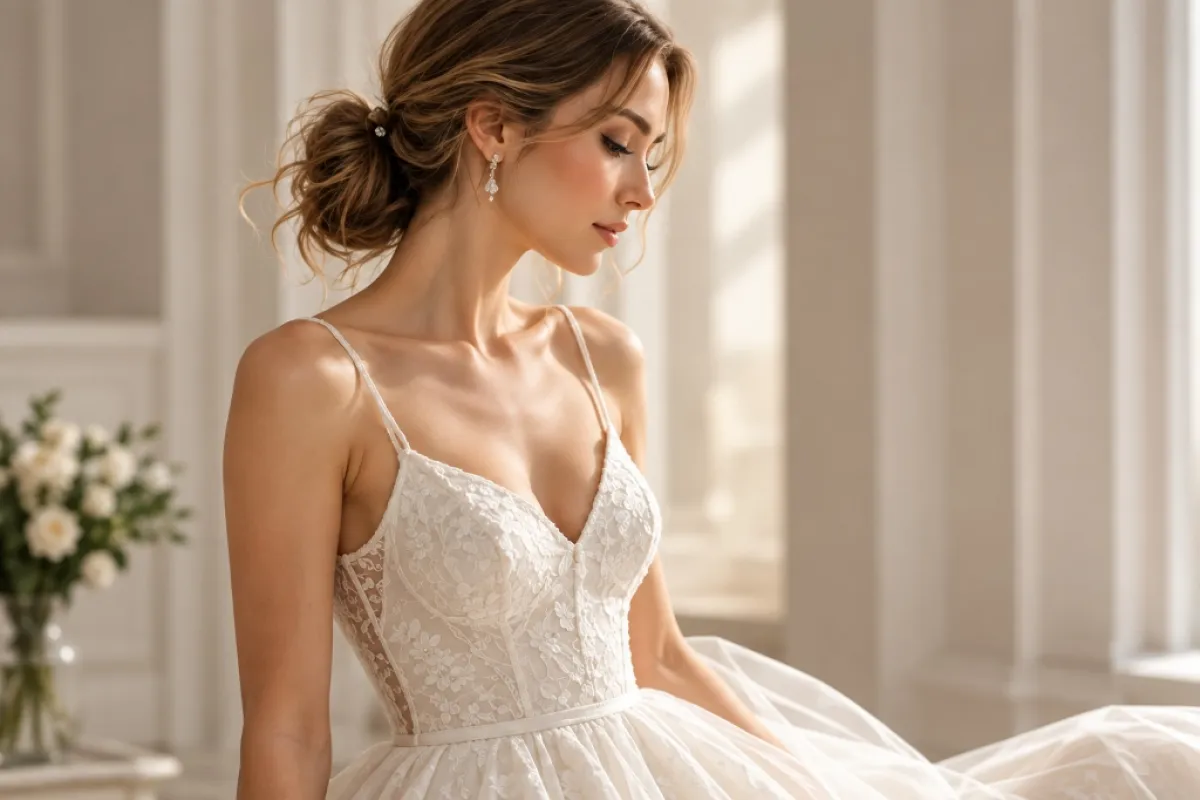
Alterations
Most wedding dresses need some alteration, and that is normal rather than a sign the size was wrong. Some changes are routine; others are harder or impossible, which is why ordering to your largest measurement matters.
| Alteration | Typical difficulty |
|---|---|
| Hemming | Straightforward; more complex with lace or several layers |
| Taking in the bodice | Routine |
| Adjusting straps | Routine |
| Adding a bustle | Common |
| Letting out | Limited by the seam allowance |
If you are between two sizes on the designer’s chart, the same principle applies as with everyday clothes — see what to do between sizes, and which measurement decides your dress size.
Fabric and Silhouette
Fabric changes how a dress fits and how it feels over a long day. Crepe is smooth and follows the body; satin has more structure and shine; lace adds texture and is harder to alter; tulle adds volume without weight. The silhouette — A-line, sheath, ballgown, mermaid — changes where the fit matters most. Dress types and how they fit covers each shape.
Before the appointment, read how to measure for a dress so your own numbers are ready. The body shape calculator helps you know which silhouettes to try first, and the cost per wear calculator is useful if you are deciding between a dress you will wear once and one you could wear again. Buying the ring too? See how to find a ring size without asking.
Frequently Asked Questions
Do wedding dresses run small?
Usually, yes. Bridal sizing is set by each designer and generally runs smaller than everyday sizing, so the label number is often higher.
How long does a wedding dress take to arrive?
Made-to-order dresses commonly take several months. Ask each shop for its own timeline, including alterations.
Should I order a smaller size?
No. Order the size that fits your measurements now. Dresses are much easier to take in than to let out.
How many fittings will I need?
Usually two or three after the dress arrives, with the final one close to the date.
Are alterations included in the price?
Often not. Ask for an alterations estimate before ordering.
How many people should I bring to an appointment?
A small number whose opinion you trust. Larger groups tend to make the decision harder rather than easier.
For the history of the wedding dress, see wedding dress, and for how garments are adjusted after purchase, alterations.