How to Dress Like a European Woman (Without the Costume)

Ask how to dress like a European woman and you will usually get a shopping list: trench coat, white shirt, ballet flats, gold hoops. The list is not wrong, but it explains nothing. The real difference is not what European women own — it is how they use it.

Copy the list and you end up in a costume: the right pieces, worn in a way that looks borrowed. What follows are the five principles underneath the list, which travel to any wardrobe and any style. If you want the list itself, with the reasoning attached, the companion piece on the ten pieces European wardrobes are built on covers it. Both are part of our European Style guides.

European style is a method, not a look. Repeat good pieces, fit before size, fabric before print, one point of interest, and dress for the city you are actually in.

01 Repetition

A European woman will wear the same well-cut trousers three times in a week and think nothing of it. Outfits are built from a rotation of maybe fifteen pieces, so every item has to earn its place. This is why the clothes look considered: they have been worn enough times to be understood.

Repetition works because the palette is narrow. When every piece sits in the same small family of colours, each combination looks different enough that nobody notices the trousers are the same. The few statement pieces go further, too, because they are worn against a quiet background rather than competing with other statements.

The practical version is a small core — two or three trousers, a few knits, a coat — worn constantly, with everything else chosen to work with that core.

Repetition works when the pieces were chosen to work together from the start.

02 Fit Over Size

The label means very little. European sizing varies more between brands than most people realise, and a size 38 in one shop can fit like a 36 or a 40 in the next. Choosing by fit rather than by number is the first habit that changes how clothes look.

A tailor is a routine part of buying, not a last resort. Hems, sleeves and waists are cheap to alter and make an enormous difference; the same trousers at the right length look like a better pair altogether.

Fit is what makes inexpensive pieces look considered and expensive ones look worth the money. Convert by measurement with the clothing size converter, and if you often fall between two sizes, read what to do between sizes.

Budget for alterations when you buy. A trouser hemmed to your shoe looks more expensive than a better trouser at the wrong length.

03 Fabric Before Print

Natural fibres — wool, cotton, linen, silk — age better and hold their shape longer. They also look better after the tenth wear than synthetics do after the second, which matters in a wardrobe built on repetition.

Texture does the work print does elsewhere: a ribbed knit, a washed linen, a brushed wool, a soft leather. An outfit in four neutrals can be interesting purely because each piece has a different surface.

Print is used, but as one piece rather than a theme — a striped top, a patterned scarf, a single floral dress. See which pieces are worth spending on for where fabric quality pays back most.

Four neutral fabrics side by side: ribbed oatmeal knit, sand linen, brushed grey wool and tan leather.

04 Restraint

One point of interest per outfit. It might be a colour, a shoe, a bag or a piece of jewellery; everything else supports it. That is what stops an outfit looking busy, and what makes the single strong piece noticeable at all.

A narrow palette makes restraint easy, because the neutral base is already there. Most outfits are three neutrals and one accent, and the accent changes more often than anything else.

Restraint is not the same as minimalism. The point of interest can be loud — a bright red bag, a bold earring. It simply is not competing with anything else.

A narrow palette is what makes one strong piece stand out.

05 City Over Country

“European” is not one style. Copenhagen, Paris and Milan dress quite differently, and the differences matter more than the similarities when you are actually getting dressed.

Dressing for the actual city — its weather, how much walking it involves, its local conventions — matters more than dressing to a national stereotype. The best-dressed person in any European city is usually the one dressed for that day in that place.

CopenhagenParisMilan
ShoesTrainers with everythingFlats and ankle bootsLoafers and heels
PaletteNeutrals with one bold colourNarrow, navy and blackTonal warm neutrals
TailoringOversized, mixed with casualFitted, understatedSharp, formal

For travellers, this means packing for the place rather than for an image of it. See Copenhagen style in detail, how French women buy shoes, and what to wear in Europe month by month.

Making It Yours Rather Than a Costume

The five principles work inside any personal style. A romantic dresser applies restraint differently from a minimal one; a natural style repeats relaxed pieces rather than tailored ones. Adopting all five does not mean adopting a single “European look” — it means dressing more deliberately in your own.

That is the difference between a costume and a style. A costume copies the pieces; a style copies the method and applies it to what you actually like wearing. Your body shape matters less than you might think — the body shape calculator tells you which cuts sit well, but every principle above works on every shape.

The principles are the same for everyone. How they look depends on your style — the quiz tells you your dominant and secondary one.

None of this is a rule. Plenty of European women dress in none of these ways, and the principles describe a tendency, not a nationality.

What European Style Is Not

  • A specific shopping list
  • Expensive by definition
  • Only for one body type, age or size
  • The same in every country
  • About looking effortless while trying very hard

For the classic outerwear piece, read how to choose a trench coat; for making the money go further, the cost per wear calculator.

Frequently Asked Questions

How do I dress like a European woman?

Build around fit, fabric and a small set of repeated pieces rather than trends. Keep a neutral base with one point of interest per outfit, and dress for the city you are in.

What do European women wear?

Mostly well-fitting basics in natural fabrics and a narrow palette — coats, straight trousers, knits, denim, flats and boots. How they are worn matters more than what they are.

Is European style expensive?

Not necessarily. It relies on fewer pieces, fit and fabric, which often means spending less overall.

How do I look European without looking like a tourist?

Dress for the local weather and walking, choose comfortable shoes, and avoid dressing to a stereotype of the city.

Is French style the same as European style?

No. French style is one strand of it. Copenhagen and Milan dress quite differently.

Can European style work for any body type?

Yes. The principles — fit, fabric, restraint — work on every body shape and size.

For more on why natural fibres last, see natural fibres, and for the idea of a small repeated wardrobe, the capsule wardrobe.

European Wardrobe Essentials: The 10 Pieces That Do the Work

Ask what a European woman keeps in her wardrobe and you will get a list. Trench coat, white shirt, straight trousers, flats. The list is accurate enough — walk through Copenhagen or Milan and you will see most of it — but owning the ten items does not produce the result, which is why so many people buy the list and end up looking like they bought a list.

What follows is the same ten European wardrobe essentials with the reasoning attached: what each one does in an outfit, what makes a good one, and what happens when it is missing. If you want the argument rather than the inventory, the companion piece on how European women actually get dressed covers the five principles underneath all of this. Both sit in our European Style guides.

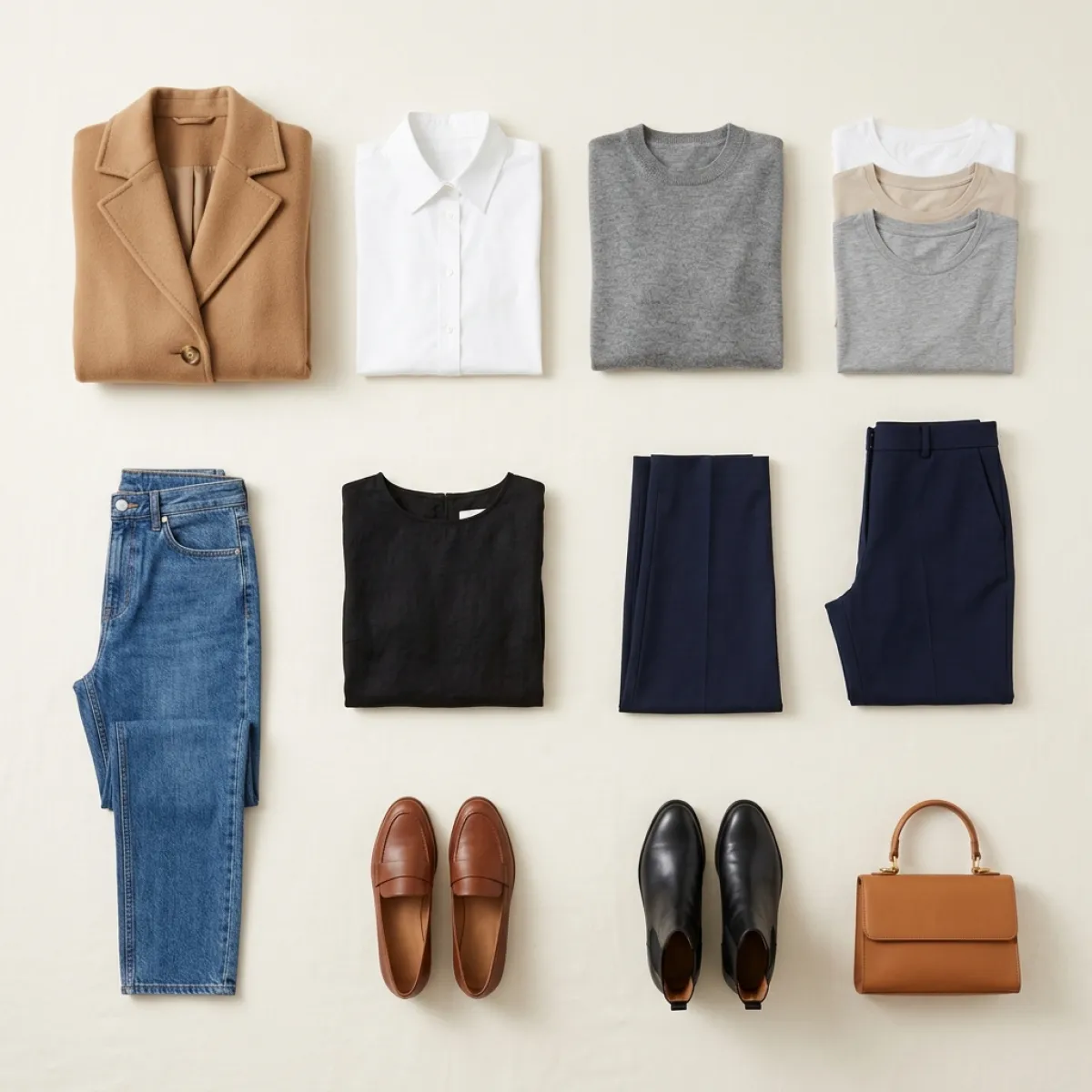
European wardrobes are small and repetitive by design. Ten well-chosen pieces in a coherent palette produce more outfits than thirty that were bought one at a time, because each new item has to work with everything already there.

What Makes This a European Wardrobe Rather Than Just a Small One

The size of a European wardrobe is a consequence, not a goal. Most of the budget goes on fit and fabric — a coat that sits properly at the shoulder, trousers in a wool with enough weight to hold their line — and when each piece costs a little more and lasts a lot longer, the count stays low on its own.

The palette is the second half of it. Neutrals that all work with each other — navy, camel, grey, cream, black, a single accent colour — mean almost anything in the wardrobe combines with almost anything else. That is what makes repetition invisible: the same trousers worn three times in a week look different each time because the pieces around them change.

The third half, if a wardrobe can have three, is restraint. One piece per outfit carries the interest — a coloured bag, a good shoe, a striking earring — and the rest stays quiet so that it can.

This is a European convention rather than a rule. Copenhagen wears trainers with tailoring and Milan does not; both are working from the same ten pieces. Our guide to Copenhagen style shows how differently the same basics can be worn. Ten wardrobe pieces laid flat in a grid: a camel coat, white shirt, grey knit, three t-shirts, navy trousers, denim, a black dress, leather flats, ankle boots and a tan bag.

European Wardrobe Essentials: The Ten Pieces

01 — A Coat That Fits the Shoulders

What it does: sets the silhouette of every outfit worn under it from October to March, and is the piece most often seen.

What makes a good one: the shoulder seam sitting where your shoulder ends, enough room for a knit underneath, and a length that works with both trousers and a dress.

Where it goes wrong: buying for the colour rather than the shoulder. A coat can be altered almost anywhere except the shoulder. Our guide to choosing a trench coat goes through the fit in detail.

02 — Straight-Leg Trousers in a Neutral

What it does: the workhorse bottom. Worn two or three times a week in most European wardrobes and expected to look the same each time.

What makes a good one: a fabric with some weight so it holds its line, and a hem finished to your actual shoe height rather than the shop’s guess.

Where it goes wrong: a length set for heels and then worn with flats. Size by measurement, not by the label — the clothing size converter turns your measurements into European, UK and US sizes.

03 — A White Shirt

What it does: the one piece that reads formal or casual depending entirely on what it is worn with.

What makes a good one: an opaque fabric, a collar with some structure, and a cut that does not pull at the button line.

Where it goes wrong: buying it slightly too small and then only wearing it open over something else.

04 — A Fine Knit

What it does: the layer between a t-shirt and a coat, and the one that makes an outfit look considered rather than assembled.

What makes a good one: merino or a fine cotton, plain, in a colour from your base palette.

Where it goes wrong: chunky knits look better on a hanger and work in fewer outfits.

05 — Plain T-Shirts, Three of Them

What it does: the base under everything, and worn more often than anything else on this list.

What makes a good one: a fabric heavy enough not to cling, a neckline that holds its shape after washing, and a length that works tucked.

Where it goes wrong: treating them as disposable and then wearing tired ones under good tailoring.

06 — Denim That Fits at the Waist

What it does: the weekend bottom, and increasingly the weekday one.

What makes a good one: a waistband that sits without a belt, and a leg shape you would wear with both flats and boots.

Where it goes wrong: sizing by the label. Jeans vary more between brands than almost any other garment — read how to measure for jeans and run the numbers through the jeans size converter before ordering.

07 — One Dress That Works Day to Evening

What it does: the outfit that requires no decisions, which is most of its value.

What makes a good one: a fabric that does not crease in a chair, a length you can walk in, and a neckline that works with a coat over it.

Where it goes wrong: buying the occasion dress first and the everyday one never. The dress size calculator tells you which of your measurements decides the size.

08 — Flat Leather Shoes

What it does: the shoe worn on ordinary days, which in most European cities means walking a real distance in it.

What makes a good one: leather that softens rather than creases, and a sole thick enough for pavement.

Where it goes wrong: buying a pair that needs breaking in for a trip that starts next week. See how French women buy shoes for the habits that make a pair last.

09 — Ankle Boots

What it does: extends the wardrobe through autumn and winter without changing anything else.

What makes a good one: a heel low enough to walk on, a shaft that ends where your trousers end, and a colour that works with both your coat and your bag.

Where it goes wrong: a heel height chosen in a shop rather than on a street.

10 — One Structured Bag

What it does: carries everything and finishes the outfit, which is why it is worth more than the average piece here.

What makes a good one: a size that holds what you actually carry, a strap you can wear crossbody and on the shoulder, and hardware that is not the point of it.

Where it goes wrong: several bags that each do one thing, rather than one that does most.

  • A coat that fits the shoulders
  • Straight-leg trousers in a neutral
  • A white shirt
  • A fine knit
  • Three plain t-shirts
  • Denim that fits at the waist
  • One dress that works day to evening
  • Flat leather shoes
  • Ankle boots
  • One structured bag

What the List Leaves Out

Fit does more than selection. Two people can own exactly these ten items and look entirely different, and the difference is usually a tailor. Taking up a hem, shortening a sleeve or taking in a waist costs less than most people assume and changes more than another purchase would. Put the alteration cost into the cost per wear calculator and it rarely changes the answer.

Colour coherence is what makes ten pieces behave like thirty outfits. A narrow palette is not an aesthetic preference; it is what allows anything to be worn with anything. If you have never set one, the personal colour palette generator turns your colour season into swatches you can shop with.

And the list is a starting point, not an identity. What belongs in your ten depends on what your week actually requires — a uniform at work changes it entirely, as does a mild climate, as does a style that leans romantic rather than minimal.

Nothing on this list is required. A wardrobe that serves your week is working, whatever is in it, and no ten items make that decision for you.

These ten are a general list. The capsule builder produces one for your climate, your week and the number of pieces you actually want.

Building From the Ten

Order matters. Start with the coat and the trousers, because everything else is chosen to work with them. Add the shoes before the extras, because they decide which trouser lengths work. Leave the bag until last: it is the most expensive per item and the easiest to get wrong early, before you know what your wardrobe actually needs it to go with. Our guide to which pieces are worth spending on sets out where the money goes furthest.

Set the palette before buying the third piece, not after the tenth. If you are building from scratch rather than editing, the year-round capsule wardrobe checklist covers the seasonal pieces that sit around this core. And if you are not sure which of these pieces suit your own style, the personal style quiz gives you a dominant and a secondary style rather than a single word.

Frequently Asked Questions

What are the European wardrobe essentials?

A coat, straight trousers, a white shirt, a fine knit, plain t-shirts, denim, one versatile dress, flats, ankle boots and a structured bag. The list matters less than the fit and the palette they share.

How many pieces should a European wardrobe have?

Most sit between twenty-five and forty items including shoes and outerwear. Ten of those do most of the work; the rest are seasonal or occasional.

Is a European wardrobe the same as a capsule wardrobe?

They overlap but are not the same. A capsule is a deliberate exercise with a set count; a European wardrobe is usually just what accumulates when pieces are bought slowly and to a palette.

Where should I spend the most?

The coat, the boots and the bag, in that order. They are worn most, seen most and last longest, which is where cost per wear favours spending more.

Do I need all ten at once?

No, and buying them at once is the most common way to end up with a wardrobe that does not fit together. Start with the coat and the trousers and let the rest follow them.

For the principles behind the pieces, read How to Dress Like a European Woman. For more on the idea of a small, deliberate wardrobe, the history of the capsule wardrobe is a useful background read.

How French Women Buy Shoes: Fewer Pairs, Worn for Years

Ask what French women wear on their feet and the answer is ballet flats, loafers and ankle boots — accurate, and not very useful. What is distinctive about French women’s shoes is not the shoes themselves but how they are chosen and kept. Fewer pairs, bought slowly, in leather that improves with wear, and taken to a cobbler rather than thrown away. The result is a shoe collection that looks considered because every pair has been worn long enough to be comfortable.

These are tendencies rather than rules, and plenty of people in Paris buy shoes like everyone else. But the habits below are worth borrowing wherever you live, and none of them requires spending more overall. More in our European Style guides.

Buy fewer pairs, in leather, and keep them in repair. A small collection of well-kept shoes costs less over ten years than a large one replaced every season.

The Shoes French Women Wear Most

Leather Flats

The everyday shoe for a walking city. A sole thick enough for pavement matters far more than the shape of the toe, and a flat with a paper-thin sole is a flat that will hurt by the afternoon.

Loafers

Flats with more structure. They read smarter with tailoring and work just as well with denim, which is why so many European wardrobes have a pair.

Ankle Boots

The autumn and winter answer. A low, walkable heel and a shaft that ends where the trousers end. The rest of the core wardrobe is built to work around them.

Seven Habits Worth Borrowing

1. Buy in the Afternoon

Feet swell through the day. A shoe fitted in the morning is often tight by evening, so shop later rather than earlier.

2. Walk in Them Properly Before Buying

Not three steps on carpet. A full circuit of the shop, including any hard floor, and a moment standing still.

3. Choose Leather That Softens

Good leather moulds to the foot over the first few weeks. Synthetic uppers tend to crack at the flex point instead.

4. Fewer Pairs, Worn in Rotation

Letting a pair rest a day between wears lets the leather dry out fully, which keeps it in shape for much longer.

5. Resole Rather Than Replace

A good cobbler can replace soles and heels several times on a well-made shoe. The upper, once it has moulded to your foot, is the valuable part.

6. Use Shoe Trees

Cedar shoe trees absorb moisture and hold the shape between wears. They are one of the cheapest ways to add years to a pair.

7. Size by the Brand, Not by Habit

Shoe sizes vary between brands as much as clothing does. Check each brand’s own chart rather than assuming your usual number. The same applies to clothes — our clothing size converter works from measurements for that reason.

Stand for the fitting. Feet spread under weight, and a shoe that fits while you sit can be tight the moment you stand up. A worn brown leather loafer with a scuffed sole and a worn-down heel. The same brown leather loafer after resoling, with a new sole and heel.

Why Fewer Pairs Cost Less

A well-made pair worn several times a week and resoled twice can last many years. A cheaper pair worn the same way often lasts a season or two before the sole separates or the upper cracks. Over a decade, the first pair usually costs less per wear even at several times the price.

Include the cost of resoling in the calculator’s alterations field. A shoe that can be repaired usually comes out well ahead.

Shoes sit alongside coats and bags as the pieces most worth spending on — see which pieces are worth spending on.

Caring for Leather Shoes

After Each Wear

Wipe off dust and marks, let the shoes dry naturally away from heat, and put the shoe trees in.

Regularly

Condition the leather every few weeks of wear so it stays supple, and polish if the finish calls for it.

Weather

Apply a protective treatment before the first rainy season, and reapply as the leather starts to darken quickly in the wet.

Never dry wet leather shoes on or near a radiator. The leather hardens and cracks, and that damage cannot be repaired.

Shoes for Travel

If you are packing for a European trip, the same rules apply with more force: two genuinely walkable pairs beat three that look good. Our guides to what to pack for Italy in summer and what to wear in Europe in winter cover the right pairs for each season, and the luggage weight calculator shows how much of your allowance they take — usually more than the clothes.

Which shoes suit you also depends on your style. The personal style quiz gives you a dominant and a secondary style, and the capsule wardrobe builder tells you how many pairs your week actually needs. For the bigger picture, see how to dress like a European woman.

Frequently Asked Questions

What shoes do French women wear?

Mostly leather flats, loafers and low ankle boots — shoes that work in a walking city. The habit that matters more is buying fewer pairs and keeping them in repair.

When is the best time to buy shoes?

In the afternoon, when feet are at their largest. Shoes fitted in the morning can feel tight later in the day.

How long should good leather shoes last?

Many years with rotation, shoe trees and regular resoling. The upper of a well-made shoe usually outlasts several sets of soles.

Are shoe sizes the same across European brands?

No. Sizing varies between brands, so check each brand’s own size chart rather than assuming your usual number.

Is it worth resoling shoes?

Usually, for well-made leather shoes. Resoling costs far less than a new pair and keeps a shoe that has already moulded to your foot.

For more on caring for a pair, see how shoe trees work, and the construction method behind many resoleable shoes, the Goodyear welt.